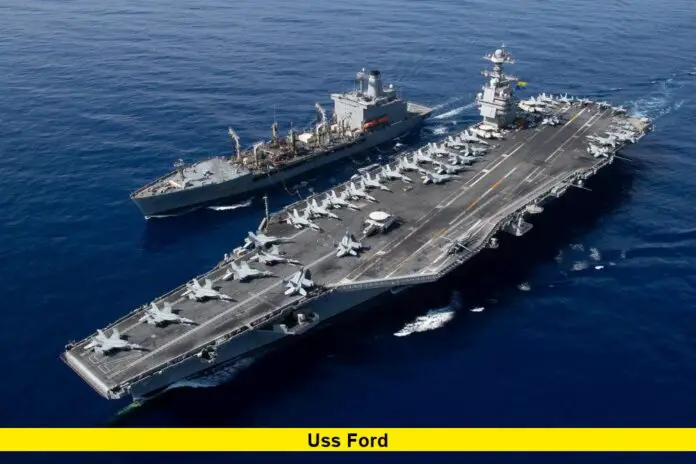
The USS Ford has embarked on a deployment to Latin America that marks a substantial escalation in U.S. naval posture in the Western Hemisphere. In this article we unpack why the carrier’s movement matters, the broader strategy it signals, and what’s at stake for regional security.
Why the USS Ford deployment is so significant
The USS Gerald R. Ford (CVN-78) — often simply voiced as the USS Ford — is the most advanced, largest aircraft carrier in the U.S. Navy’s inventory. That a vessel of this scale is now being sent into the waters near Latin America signals more than routine patrol: it is a clear demonstration of intent and capability.
According to recent announcements by the United States Department of Defense, the deployment enters the area under the command of United States Southern Command (SOUTHCOM) with the purpose of enhancing United States capacity “to detect, monitor and disrupt illicit actors and activities” that threaten national security and regional stability. Reports indicate the carrier is joining an existing naval build-up in the Caribbean and off the coasts of Central and South America.
What the deployment looks like on the ground (and at sea)
The scale of resources being marshalled is noteworthy:
- The USS Ford will operate as the core of a carrier strike group that may include destroyers, cruisers, support vessels, submarine assets and air-wing detachments.
- The region already hosts several warships and aircraft tasked with counter-narcotics, surveillance and force-projection roles.
- Recent commentary from the Pentagon describes the mission as far more ambitious than standard anti-drug-smuggling patrols — hinting at a shift toward higher-end naval operations in the hemisphere.
Strategic motives: Under the surface of the stated mission
On the surface, counter-narcotics work is the explained rationale for the deployment. But beneath that lie several deeper strategic currents:
- The U.S. appears to be recasting drug-trafficking networks and trans-national criminal organisations as national security threats akin to militant groups. That conceptual shift enables the use of heavier military assets and a broader operational envelope.
- Stationing the USS Ford and its strike group in Latin America serves as a signal to regional governments — particularly in petro-states or places historically aligned against U.S. influence — that Washington is willing to project large-scale power in its own hemisphere.
- The move could serve as leverage in broader diplomacy: the naval presence becomes a tool of pressure and deterrence, not just interdiction.
Regional reactions and the diplomatic dimension
The deployment has not gone unnoticed in Latin America. Key responses include:
- Governments in the region express concern that the U.S. is militarising the hemisphere rather than cooperating with regional partners. The presence of a supercarrier offshore brings heightened geopolitical weight.
- One government in particular – Venezuela – has condemned the deployment as a threat to its sovereignty, framing it as part of a broader campaign of pressure and isolation.
- Within the U.S., some members of Congress and foreign-policy observers question the legal basis for deploying major naval assets in the region without clear authorisation for operations that may escalate beyond maritime patrol.
Risks, uncertainties & open questions
Such a move carries substantial risks and leaves many questions unanswered:
- A carrier strike group operating close to littoral states and contested waters raises the danger of miscalculation or clash — either with state actors or non-state maritime forces.
- Legal and oversight issues abound. If missions evolve from narcotics operations to strikes or land-based actions, the rules of engagement, sovereignty concerns and congressional oversight become acute.
- Operationally: the capacity of a high-end naval platform like the USS Ford to actually deter or dismantle land-based drug production networks remains an open question. The logistics, cost and political implications of a long-term carrier presence in the region are significant.
Possible trajectories: What to expect next
Observing the deployment, several developments will bear watching:
- Mission evolution: Will the USS Ford remain in classic carrier-strike role (air operations, maritime surveillance) or will it be tasked with direct action against land-based targets, perhaps in collaboration with other forces?
- Duration and permanence: Will this be a short-term surge or the beginning of a prolonged presence in the hemisphere? A sustained assignment would signal a structural shift in U.S. naval posture.
- Regional alliances and responses: How will Latin American governments respond — with cooperation, alignment with other major powers, or increased militarisation? The diplomatic ripple effects could reshape hemispheric security.
- U.S. domestic politics and oversight: Will Congress and the public justify the deployment under the authorities given, or will new legislation or debate arise to govern such operations more tightly?
Snapshot: Key facts at a glance
| Item | Detail |
|---|---|
| Ship | USS Gerald R. Ford (CVN-78) – U.S. Navy’s newest, largest carrier |
| Mission region | Caribbean/Latin America – under SOUTHCOM’s purview |
| Purpose | Enhanced U.S. force presence to disrupt illicit actors & safeguard U.S. interests |
| Strategic shift | From routine counter-narcotics patrols toward higher-end naval projection |
| Key risk factors | Sovereignty issues, legal/oversight questions, regional diplomacy |
In launching the deployment of the USS Ford to Latin America, the United States signals a new chapter in its military posture—where the dynamics of border security, drug interdiction and hemispheric influence converge. The implications extend far beyond the waves and into diplomacy, defence policy and regional realignment.
Bold Closing Invitation: I welcome your thoughts—share your views in the comments below or stay tuned for more updates on how this deployment will evolve and affect the region.

