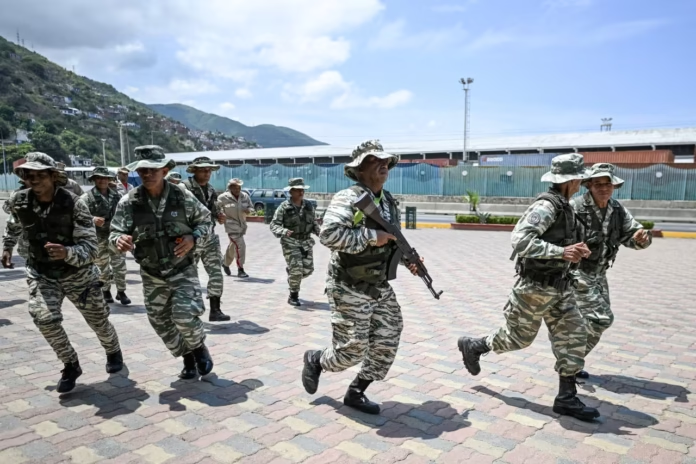
The venezuela military buildup has intensified dramatically in recent weeks, signaling one of the most significant regional military escalations in Latin America in decades. The government of President Nicolás Maduro has deployed hundreds of thousands of troops, activated air defense systems, and mobilized civilian militias as U.S. military activity increases across the Caribbean. This development marks a defining moment in Venezuela’s recent history, with growing global concern over how close both nations are edging toward confrontation.
Table of Contents
Massive Troop Mobilization Across the Country
The Venezuelan Defense Ministry recently announced that approximately 200,000 troops have been mobilized nationwide. These forces include army units, navy and air force divisions, as well as thousands of civilian militia members who have undergone rapid training.
The mobilization is not confined to one area—it covers the entire country:
- Coastal Regions: Venezuela’s navy and coastal defense units have been reinforced along the Caribbean Sea and the Gulf of Venezuela to monitor approaching foreign vessels.
- Western Borders: Troops have increased patrols along the Colombian frontier to prevent infiltration and strengthen border control.
- Air Bases and Missile Defense: The air force has placed air defense systems on standby, with radar and missile installations now active around major military facilities.
- Civic Militias: Tens of thousands of Venezuelans have joined state-run militia training programs, a move designed to create a “people’s defense” in case of external aggression.
The mobilization, described by Venezuelan officials as “defensive and patriotic,” is being portrayed internally as a necessary measure to protect national sovereignty.
U.S. Military Presence Sparks Venezuelan Reaction
The venezuela military buildup comes as the United States expands its own military operations in the Caribbean. American naval groups, including aircraft carriers, warships, and submarines, have been stationed in the region as part of broader efforts to counter narcotics trafficking and monitor Venezuelan activities.
While the U.S. insists that its regional presence is focused on anti-drug operations and freedom of navigation, Venezuela views it as a direct threat. The Maduro administration argues that the buildup is an attempt to intimidate and destabilize the country.
In response, Venezuela has:
- Deployed anti-ship and surface-to-air missile systems.
- Conducted live-fire military exercises near its coastline.
- Increased aerial patrols using Russian-made fighter jets.
- Ordered intelligence surveillance of international airspace and sea routes.
The government has declared that any violation of its territorial integrity will be treated as an act of aggression.
Strategic Objectives Behind the Military Buildup
The venezuela military buildup is not merely a tactical move—it serves several political and strategic objectives:
- Deterrence:
Venezuela aims to deter any potential U.S. or allied intervention by demonstrating strength and preparedness. The presence of a large and mobilized military makes direct confrontation more costly and politically risky. - Internal Consolidation:
The Maduro administration is using the military buildup to reinforce national unity and project control at a time when the country faces economic hardship and political pressure. Military parades and public displays of strength serve as symbols of resilience. - Regional Influence:
Venezuela seeks to remind neighboring nations—particularly Colombia and Brazil—that it remains a major military power in South America. By displaying military readiness, Caracas aims to project authority and deter regional alignment with U.S. interests. - International Messaging:
The buildup sends a global signal that Venezuela will resist external influence and maintain sovereignty, regardless of sanctions or political isolation.
Inside the Venezuelan Armed Forces
Venezuela’s armed forces, officially known as the Bolivarian National Armed Forces (FANB), are composed of four main branches: the Army, Navy, Air Force, and National Guard. In recent years, the structure has expanded to include the Bolivarian Militia, a civilian volunteer force that supports the military during emergencies or conflict.
- Army: The backbone of Venezuela’s defense, with armored and infantry divisions concentrated near borders and major cities.
- Navy: Operates in both Caribbean and Atlantic waters, focusing on anti-ship and coastal defense operations.
- Air Force: Equipped with Russian aircraft such as Sukhoi fighters, capable of intercepting foreign aircraft near Venezuelan airspace.
- Militia: A large auxiliary force that enhances Venezuela’s manpower and allows rapid mobilization during crises.
The Maduro government has invested heavily in missile defense, communications systems, and cybersecurity infrastructure to modernize these branches. However, challenges remain—particularly in maintenance, logistics, and international procurement due to ongoing sanctions.
Economic Strain and Military Priorities
Despite limited financial resources, Venezuela has prioritized defense spending. Economic sanctions and declining oil revenues have reduced the country’s access to foreign equipment and parts, but domestic production and partnerships with allies like Russia and Iran have helped maintain key military assets.
Fuel shortages, aging equipment, and a lack of spare parts have strained operations, but the government’s focus on self-reliance has led to increased domestic production of ammunition, drones, and surveillance systems.
Economically, the buildup is also being used to boost morale and national pride. Government media portray soldiers and militia members as defenders of independence, reinforcing the narrative that Venezuela is standing firm against external threats.
Regional and Global Reactions
Neighboring countries have responded cautiously to the venezuela military buildup.
- Colombia has increased border surveillance but stated that it does not seek confrontation.
- Brazil has maintained neutrality but expressed concern about potential spillover effects if tensions escalate.
- Caribbean nations have called for de-escalation, emphasizing diplomacy over militarization.
Globally, reactions are mixed. Some governments see the mobilization as a sovereign right, while others view it as destabilizing. The situation has drawn attention from international organizations that are monitoring both humanitarian and security implications.
The buildup also complicates Venezuela’s foreign relations. Countries attempting to mediate—such as Mexico and several European nations—now face the challenge of balancing diplomatic engagement with growing military risks.
Risks of Escalation and Miscalculation
The current situation carries significant risks. With Venezuelan and U.S. military forces operating in proximity, even a small incident could trigger a rapid escalation. A misinterpreted movement, radar lock, or accidental encounter between aircraft could lead to confrontation.
Additionally, the Venezuelan government’s reliance on militia forces increases unpredictability, as untrained or semi-trained units might act outside formal command channels. Both sides have emphasized they do not seek war, but the environment remains volatile.
Experts warn that the ongoing military posturing could have long-term consequences, including disrupted trade routes, regional instability, and humanitarian crises if sanctions intensify or armed conflict erupts.
Implications for the United States
For U.S. policymakers and citizens, the venezuela military buildup represents more than a foreign policy issue—it connects directly to national and regional security.
- Drug Trafficking: The U.S. argues that Venezuelan networks play a key role in regional narcotics movement. Increased military activity is seen as an opportunity to disrupt these routes.
- Migration: Any instability in Venezuela could increase migration toward the U.S., particularly if conflict leads to civilian displacement.
- Geopolitical Competition: Venezuela’s alliances with Russia, China, and Iran create additional layers of complexity, giving the crisis global dimensions.
- Energy Security: Venezuela holds vast oil reserves; conflict in the region could disrupt global energy markets.
The U.S. must therefore navigate between deterrence and diplomacy—asserting power while avoiding escalation that could draw it into a prolonged regional conflict.
Possible Scenarios Ahead
- Controlled Standoff:
Both sides continue military operations without direct conflict, maintaining pressure through exercises and rhetoric. - Limited Engagement:
A naval or aerial encounter occurs, but diplomacy quickly intervenes to prevent full-scale escalation. - De-escalation Through Mediation:
Regional and international partners broker dialogue, easing tensions and leading to gradual military drawdowns. - Wider Regional Crisis:
A direct clash triggers broader instability across Latin America, affecting neighboring states and global markets.
At this stage, the first scenario remains most likely, but the margin for error is shrinking as deployments increase and communication remains limited.
The Road Ahead
As of November 2025, Venezuela remains in a state of full military readiness. Regular exercises, increased surveillance, and the integration of civilian forces show that the government intends to maintain its defense posture indefinitely. Meanwhile, U.S. assets continue to operate nearby, ensuring this standoff will persist into the foreseeable future.
Diplomatic initiatives may still offer an off-ramp, but trust between both governments is at its lowest point in years. The situation underscores how military and political power dynamics can shift rapidly in a region already marked by instability.
The venezuela military buildup has become a defining test of power and diplomacy in the Western Hemisphere. How long this standoff lasts—and whether it turns toward peace or confrontation—will depend on choices made in the coming weeks. Stay tuned, and share your thoughts below on how this escalating situation might reshape Latin America’s future.

