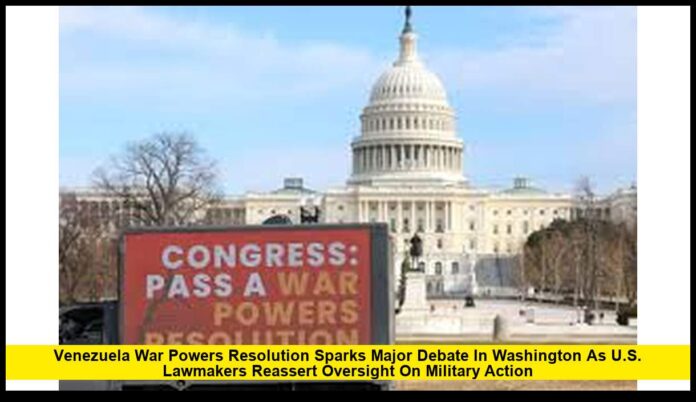
The Venezuela War Powers Resolution has reignited a heated debate in Washington, D.C., as lawmakers from both parties reaffirm Congress’s constitutional role in authorizing U.S. military involvement abroad. The resolution, introduced in early January 2026, comes in response to growing tensions in South America and renewed discussions over the limits of presidential authority when deploying U.S. forces without congressional approval.
Table of Contents
Congress Moves to Reassert Constitutional Authority
According to verified government updates as of January 2026, the Venezuela War Powers Resolution was introduced after increased U.S. military presence in the Caribbean drew bipartisan concern. Lawmakers are emphasizing the need for transparency and congressional authorization before any potential use of force related to the ongoing crisis in Venezuela.
The measure underscores Congress’s authority under the 1973 War Powers Act, which restricts the president from sending U.S. troops into hostilities for more than 60 days without explicit congressional consent. This latest resolution serves as both a legal clarification and a political message that Congress will not allow unchecked military engagement in Latin America.
Background: Rising Tensions in the Region
The renewed focus on Venezuela comes amid continued instability in the country, which has experienced years of economic turmoil, political unrest, and mass migration. While the U.S. has supported diplomatic pressure and humanitarian initiatives, reports of military activity and naval operations near Venezuelan waters prompted congressional scrutiny late last year.
Officials have clarified that U.S. forces are currently engaged only in intelligence and humanitarian coordination, not direct combat operations. However, lawmakers have raised concerns about potential escalation without formal congressional approval—prompting the swift drafting of the War Powers Resolution specific to Venezuela.
What the Resolution Seeks to Do
The Venezuela War Powers Resolution explicitly directs the President to terminate any U.S. military involvement in or near Venezuela that is not authorized by Congress. The only exception would be defensive operations necessary to protect U.S. personnel or facilities.
The resolution reaffirms that any offensive or sustained military engagement—such as airstrikes, troop deployments, or blockades—must receive prior authorization. It also mandates regular briefings to Congress on U.S. activities in the region, ensuring greater oversight and transparency in foreign military affairs.
This move reflects growing sentiment in Congress to reclaim its role in war-related decision-making—a responsibility some lawmakers believe has been eroded by decades of executive overreach.
Bipartisan Support with Divided Interpretation
While the Venezuela War Powers Resolution has found bipartisan sponsors, the motivations behind support differ between parties. Lawmakers from both sides agree that the president must seek congressional approval for any potential military conflict. However, disagreements remain on the scope of executive authority during international crises.
Supporters from both parties stress that this measure is preventive rather than reactive. They argue that it strengthens constitutional checks and balances by requiring transparency before any U.S. involvement escalates into direct conflict. Critics, however, warn that overly restrictive provisions could hinder rapid responses to threats against U.S. interests or allies in the region.
This debate mirrors broader national discussions over U.S. foreign policy priorities, the role of military power, and Congress’s constitutional authority under Article I, Section 8, which grants the power to declare war.
Administration Response and Policy Context
The current administration has acknowledged the resolution but maintains that U.S. actions in and around Venezuela remain strictly within the bounds of humanitarian and diplomatic efforts. Officials have reiterated that there are no plans for combat operations and that recent military movements in the Caribbean are routine exercises.
However, the introduction of the resolution reflects congressional caution—especially following decades of U.S. military engagements launched without explicit authorization. Lawmakers have drawn parallels to past interventions that began as limited operations but expanded over time, such as those in Libya and Syria.
Venezuela’s Current Situation and International Reactions
Inside Venezuela, political tensions remain high following years of economic collapse, hyperinflation, and internal disputes over leadership legitimacy. Regional powers have expressed growing concern over the humanitarian crisis, which has displaced millions of Venezuelans across South America.
Neighboring countries have called for diplomatic restraint, urging the U.S. and international community to focus on dialogue and humanitarian aid rather than military pressure. The introduction of the War Powers Resolution aligns with that global sentiment, emphasizing caution and adherence to international law.
Legal and Constitutional Implications
Constitutional scholars note that the Venezuela War Powers Resolution reinforces Congress’s ability to limit executive authority in matters of war. While the 1973 War Powers Act remains the guiding framework, presidents from both parties have historically contested its restrictions, often citing their constitutional role as commander-in-chief.
This new resolution could serve as a precedent-setting measure for future foreign policy decisions. It signals Congress’s renewed determination to prevent unilateral military actions, particularly in regions where long-term involvement could entangle U.S. forces in complex political and humanitarian challenges.
Broader Foreign Policy Impact
Beyond its immediate focus on Venezuela, the resolution reflects a broader recalibration of U.S. engagement in Latin America. After years of shifting policy between sanctions, aid, and diplomacy, lawmakers are pushing for clearer boundaries on military action in the hemisphere.
Analysts note that this development marks a turning point in how the U.S. approaches regional conflicts. It reinforces diplomatic leadership and accountability over military intervention, echoing the growing public demand for transparency in foreign affairs.
Additionally, the resolution’s passage could strengthen congressional oversight not just in Latin America but in other global hotspots where U.S. involvement is under review.
Next Steps for the Resolution
The Venezuela War Powers Resolution is currently under committee review, with votes expected in both chambers in the coming weeks. If approved, it would serve as a formal warning to the executive branch to limit any military activity tied to Venezuela without congressional authorization.
Lawmakers backing the resolution anticipate a strong debate on the floor, as members discuss the balance between national security flexibility and legislative oversight. Regardless of the outcome, the measure has already reignited public discourse on constitutional war powers—a conversation that has gained renewed urgency in 2026.
The Venezuela War Powers Resolution is more than a policy measure—it’s a constitutional statement reaffirming the U.S. commitment to checks, balances, and responsible global engagement. What are your thoughts on Congress’s role in shaping military policy? Share your perspective below!

