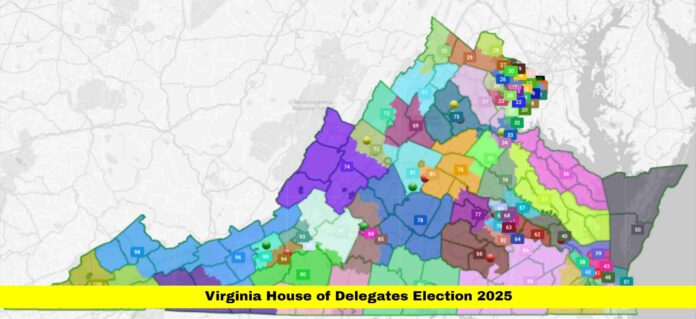
The Virginia House of Delegates election 2025 marked a defining moment in the Commonwealth’s political history, with Democrats securing a commanding majority that will shape legislation and policy for years to come. Out of 100 seats, Democrats expanded their control, gaining multiple suburban districts that had long been Republican strongholds. The result reinforces Virginia’s status as a Democratic-leaning state and signals potential shifts in both governance and redistricting.
Table of Contents
Overview of the Election Results
The 2025 Virginia House of Delegates election saw all 100 seats contested across the state on November 4. Democrats entered the race with a narrow 51-49 majority, but early returns showed strong performance in key districts, ultimately giving the party an estimated 63 seats. The win exceeded expectations and established one of the largest Democratic advantages in over a decade.
The victory strengthens Democratic control not just within the House but also across Virginia’s broader political landscape, where the party already holds the governorship. With a wider majority, Democrats can move forward with more ambitious legislative goals on education, health care, and voting rights without relying heavily on bipartisan support.
Suburban Voters Drive the Shift
The Democrats’ success in the Virginia House of Delegates election 2025 was largely powered by suburban voters. Districts in Northern Virginia, Richmond, and Hampton Roads saw significant Democratic swings, fueled by changing demographics and voter concerns over economic growth and public services.
Many of these areas have experienced rapid expansion, bringing in younger, more diverse populations. These voters prioritized affordable housing, public education, infrastructure, and climate resilience over partisan divides. Democratic candidates focused their campaigns around these community-driven issues, while Republicans leaned heavily on traditional conservative messages that failed to connect as strongly in suburban areas.
The suburbs, once considered battlegrounds, became decisive in turning the state solidly blue.
Legislative Power and Policy Direction
Democrats’ expanded control of the Virginia House gives them a stronger hand in setting legislative priorities. The new majority means quicker passage of key bills on education reform, renewable energy, healthcare expansion, and workers’ rights.
One of the major upcoming policy areas is redistricting. With their legislative majority, Democrats can now influence how future congressional and legislative maps are drawn, shaping the state’s representation for the next decade. They also plan to revisit the state’s criminal justice reform measures and environmental standards.
This majority also grants Democrats control over the House Rules and Appropriations Committees, key bodies that determine which bills move forward and how the state’s budget is allocated. It’s expected that funding will focus more on education, green infrastructure, and workforce development.
Key Factors Behind the Election Results
Several factors contributed to the Democratic surge in 2025. First, high voter turnout among young and first-time voters made a noticeable difference. Efforts to expand early voting and mail-in ballots also helped increase participation in urban and suburban areas.
Second, economic and quality-of-life issues dominated voter sentiment. Virginia’s growing technology and service sectors brought new challenges around housing costs, traffic congestion, and access to healthcare. Democrats framed their platform around practical solutions to these challenges, while Republicans faced criticism for focusing more on national partisan debates.
Third, the influence of local leadership and well-organized campaigns played a vital role. Democrats invested heavily in digital outreach, local events, and early-voting drives, ensuring visibility in every competitive district.
Finally, the presence of moderate Democratic candidates helped bridge the gap between progressive and centrist voters. These candidates appealed to independent voters and moderate Republicans who valued bipartisan problem-solving.
Impact on Redistricting and Governance
With control of both the House and key statewide offices, Democrats are expected to pursue redistricting reforms in 2026. Their plan aims to modify or bypass the current independent redistricting commission, which they argue has failed to produce fair maps in past cycles.
The outcome of this redistricting process will influence not only state politics but also Virginia’s representation in the U.S. Congress. The potential redrawing of district boundaries could solidify Democratic advantages in urban and suburban areas while reshaping competitive rural districts.
Additionally, the party’s legislative control allows them to pursue governance reforms—improving transparency, streamlining state agencies, and addressing public trust in elections.
Challenges for Both Parties Going Forward
Despite their decisive win, Democrats face the challenge of delivering results quickly. Voters expect tangible improvements in schools, transportation, and healthcare. Maintaining unity among progressive and centrist members will also be key, as internal divisions could slow momentum.
For Republicans, the 2025 loss signals a need for recalibration. The party must modernize its message to resonate with suburban and younger voters while staying connected to rural bases. Future campaigns will likely focus more on affordability, tax policy, and local economic issues rather than cultural battles.
Both parties will also contend with an evolving voter landscape as Virginia continues to grow and diversify. The next legislative session will be crucial in determining how effectively each side adapts to these realities.
Looking Ahead to the 2026 Legislative Session
The next session of the Virginia General Assembly is expected to open with a full Democratic agenda. Education reform will likely be at the forefront, with proposals to raise teacher salaries, reduce class sizes, and invest in early childhood programs.
Infrastructure improvement, particularly in transportation and broadband expansion, will also remain a top priority. Environmental policy—especially renewable energy projects—will continue to gain traction as the state pursues its long-term climate goals.
In healthcare, the new majority is expected to push for expanded access to mental health services and rural hospital funding. Economic policy debates will center on small-business support and workforce training in emerging industries like technology and green energy.
Democrats will likely use their momentum to introduce long-term planning measures, aiming to secure Virginia’s reputation as one of the best-governed states in the U.S.
Broader Significance for Virginia’s Political Landscape
The Virginia House of Delegates election 2025 underscores the state’s transformation from a traditional swing state into a Democratic stronghold. The shift highlights how suburban growth, generational change, and evolving voter priorities have reshaped Virginia’s identity.
The results also mirror broader national patterns, where suburban voters and moderate independents increasingly play decisive roles in elections. For Virginia, this dynamic could mean a period of stable Democratic governance, but it also places pressure on the party to deliver concrete policy wins that maintain voter confidence.
As Virginia continues to attract new residents, the issues of housing, education, and infrastructure will remain central to its political future. The 2025 election not only redefined legislative control but also reaffirmed voters’ focus on practical governance over partisan rhetoric.
Conclusion
The Virginia House of Delegates election 2025 represents a clear mandate for progressive governance and strategic reform. Democrats’ expanded majority has opened the door for new policy directions that could shape the state’s economy, education system, and environmental future.
However, with greater power comes greater accountability. Both parties now face a changing political environment that demands responsiveness, innovation, and collaboration. Virginia’s 2025 election results serve as a reminder that effective governance—and not party identity—ultimately determines political longevity.
Voters across the Commonwealth will be watching closely to see how this new majority turns campaign promises into action. Stay tuned and share your thoughts on what these results mean for Virginia’s future.

