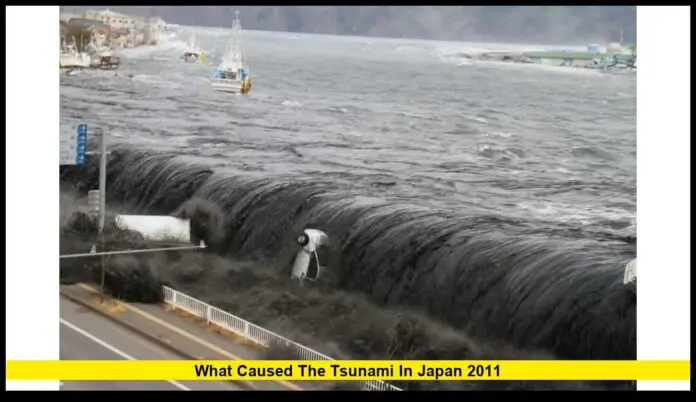
What caused the tsunami in Japan 2011 remains one of the most studied questions in modern natural disaster science. The catastrophic event, which struck Japan on March 11, 2011, was triggered by one of the most powerful earthquakes ever recorded. The disaster reshaped Japan’s coastline, claimed thousands of lives, and led to one of the worst nuclear accidents in history.
Fourteen years later, experts continue to analyze the chain of geological events that caused the massive tsunami and its long-term effects on Japan and the global community.
Table of Contents
The 2011 Great East Japan Earthquake
The event that caused the 2011 tsunami was a magnitude 9.0 megathrust earthquake. It struck off the northeastern coast of Japan at 2:46 p.m. local time on March 11, 2011.
The epicenter was located about 80 miles (130 kilometers) east of Sendai, on the eastern coast of Honshu, Japan’s largest island. The quake occurred deep beneath the Pacific Ocean along the Japan Trench, a major subduction zone where the Pacific Plate slides beneath the North American Plate.
This geological boundary is one of the most seismically active areas on Earth, responsible for many of Japan’s strongest earthquakes.
How the Earthquake Triggered the Tsunami
A tsunami is typically caused by a sudden displacement of water. In 2011, that displacement came from a massive rupture in the seafloor.
When the earthquake struck, the Pacific Plate slipped beneath the North American Plate and pushed upward with enormous force. This abrupt vertical movement displaced an estimated 3 to 5 meters (10 to 16 feet) of the ocean floor across an area roughly 180 miles (290 kilometers) long and 50 miles (80 kilometers) wide.
That shift displaced an enormous volume of seawater, sending powerful waves racing toward Japan’s coastline. Within 30 to 40 minutes, waves up to 133 feet (40.5 meters) high crashed into the northeastern coast, devastating cities and towns in Miyagi, Iwate, and Fukushima Prefectures.
The tsunami traveled inland for several miles, sweeping away homes, vehicles, and entire neighborhoods.
The Magnitude of the Disaster
The combined earthquake and tsunami killed nearly 20,000 people, with thousands more injured or missing. More than 470,000 people were displaced from their homes.
The Japanese government later declared the disaster “the most severe crisis Japan has faced since World War II.”
Here are some key figures that help illustrate the scale:
| Impact Area | Details |
|---|---|
| Date | March 11, 2011 |
| Magnitude | 9.0 (Moment Magnitude Scale) |
| Epicenter Location | 38.297°N, 142.372°E (Near Sendai) |
| Tsunami Height | Up to 133 ft (40.5 m) |
| Fatalities | 19,759 confirmed |
| Missing | 2,553 |
| Displaced People | Approx. 470,000 |
| Economic Loss | Estimated $235 billion USD |
This event remains the costliest natural disaster in recorded history, surpassing even Hurricane Katrina and the 2004 Indian Ocean tsunami in total financial damage.
Why Japan Was So Vulnerable
Japan is located on the Pacific Ring of Fire, a region known for intense seismic activity. It sits on the convergence of four major tectonic plates:
- The Pacific Plate
- The North American Plate
- The Eurasian Plate
- The Philippine Sea Plate
This unique geography makes Japan one of the world’s most earthquake-prone nations. Although Japan’s early warning systems and coastal defenses were among the most advanced, the 2011 event exceeded all design expectations.
Many coastal levees and seawalls were designed for tsunamis under 33 feet (10 meters)—less than one-third of the waves that struck during the 2011 disaster.
The Fukushima Nuclear Crisis
One of the most devastating consequences of the tsunami occurred at the Fukushima Daiichi Nuclear Power Plant.
When the tsunami waves reached the plant, they overtopped seawalls that stood 19 feet (5.7 meters) high and flooded the facility. The flooding disabled emergency generators and cooling systems, leading to core meltdowns in three of the six reactors.
The result was the worst nuclear accident since Chernobyl (1986). Radioactive materials were released into the air and ocean, prompting mass evacuations and widespread contamination concerns.
As of 2025, the decommissioning and cleanup of Fukushima continue. The Japanese government estimates the full process could take 30 to 40 years and cost over $180 billion USD.
Global Effects of the 2011 Tsunami
The tsunami’s reach extended far beyond Japan. Within hours, waves traveled across the Pacific Ocean, affecting:
- Hawaii, where waves up to 6 feet reached coastal areas.
- California and Oregon, which experienced minor flooding and property damage.
- Chile and Peru, where elevated sea levels were recorded more than 15 hours later.
In total, the tsunami affected over 20 countries, highlighting how interconnected global coastlines are when such massive underwater displacements occur.
Scientific Insights Gained
In the years since 2011, scientists have studied the event extensively to understand what caused the tsunami in Japan 2011 and how to prevent similar catastrophes.
Key discoveries include:
- The rupture zone was much larger and shifted farther eastward than initially believed.
- The vertical seafloor movement in some areas exceeded 50 feet (15 meters).
- Advanced GPS and satellite data now help track plate movement in real time.
- Japan’s early warning system successfully gave many residents 60 to 90 seconds to take cover before the ground shaking began.
These insights have led to major advancements in tsunami detection and public alert systems across the Pacific region.
Changes and Preparedness Since 2011
After the disaster, Japan implemented sweeping reforms to strengthen disaster resilience:
- Reinforced Seawalls:
Hundreds of miles of new and taller seawalls have been built, especially in the Tōhoku region. Some reach heights of 50 feet (15 meters). - Improved Evacuation Infrastructure:
Elevated escape routes, coastal evacuation towers, and clearer signage have been installed in vulnerable towns. - Enhanced Early Warning Systems:
The Japan Meteorological Agency (JMA) upgraded sensors and satellites to provide faster alerts and more accurate tsunami forecasts. - Energy Policy Reforms:
The Fukushima disaster prompted a national shift in Japan’s energy policy, reducing reliance on nuclear power and investing in renewable energy. - Community Education:
Local schools and communities now conduct regular tsunami drills, ensuring that residents know evacuation routes and emergency protocols.
These measures reflect Japan’s ongoing commitment to learning from tragedy and protecting its citizens from future disasters.
The Legacy of March 11, 2011
The 2011 tsunami left physical and emotional scars across Japan, but it also united the country in resilience and recovery. Entire communities were rebuilt on higher ground, and many survivors turned their grief into advocacy for disaster awareness and preparedness.
Today, memorials and museums across northeastern Japan honor the lives lost and share lessons with future generations. Annual ceremonies on March 11 bring together survivors, families, and officials to reflect and reaffirm the nation’s strength.
The 2011 Japan tsunami was caused by a powerful undersea megathrust earthquake that lifted the ocean floor and displaced massive amounts of water. Its impact reshaped Japan and changed global understanding of natural disasters forever.

