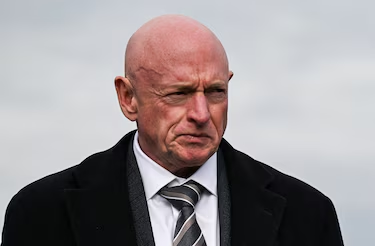
What did Mark Kelly say? The Arizona senator released a strong public statement on November 24, 2025, directly responding to the United States Department of Defense’s announcement of an investigation into his involvement in a video that told military personnel they “can refuse illegal orders.”
Table of Contents
Background: The Video, the Reaction, and His Response
In mid-November, the senator appeared in a video released as part of a joint message from several lawmakers who previously served in the military or held national security roles. The intent of the video was to speak directly to U.S. service members about their oath, their responsibilities, and the importance of constitutional fidelity. During his segment, the senator delivered the line that quickly sparked nationwide debate: “you can refuse illegal orders.” Supporters argued that the statement echoed long-standing military law and the Uniform Code of Military Justice, which makes clear that service members must not obey unlawful commands. Critics, however, claimed the timing and delivery carried political overtones that could be interpreted as encouraging defiance within the ranks.
The controversy escalated rapidly. Within days, the Pentagon announced that it was initiating a review into what it described as serious allegations of misconduct. Officials expressed concern that the message, coming from a sitting member of Congress with a distinguished military background, might erode trust, weaken the chain of command, or create confusion about the roles and responsibilities of active-duty personnel. The military’s emphasis on discipline, cohesion, and unquestioned adherence to lawful authority made the senator’s phrasing especially sensitive in this moment.
Facing mounting scrutiny, Senator Kelly issued a formal written response that outlined not only his position but the personal experiences that shaped it. He underscored that his perspective was rooted in a lifetime of service. He recounted commissioning in the U.S. Navy at just 22 years old, flying combat missions and operating in high-risk environments where the stakes were often life and death. He reminded the public that he later became a NASA astronaut, piloting and commanding space shuttle missions that demanded extraordinary precision, trust, and accountability. After retiring from both military and NASA service, he continued his commitment to national duty by entering the U.S. Senate.
In his statement, he wrote that he had “given too much to this country to be silenced by bullies who care more about their own power than protecting the Constitution.” He framed the controversy as an attempt to suppress a longstanding principle—that unlawful orders are not meant to be followed—rather than a genuine concern about military readiness.
Adding to the tension, the senator revealed that he first learned of the Pentagon’s investigation not through official channels but from a public tweet posted by the Secretary of Defense. He described the situation as both surprising and unprofessional, noting that he received no private briefing, message, or outreach before the information was broadcast across social media. For him, the manner of notification illustrated what he saw as a political move rather than a procedural one, further fueling his determination to confront the allegations head-on.
Read Also-Mark Kelly Military Service: A Deep Dive Into His Naval Aviator Career and Recent Review
Key Elements of What Mark Kelly Said
Senator Kelly laid out several core points in his response, each reflecting how he views both his duty and the backlash directed at him. First, he reiterated that the oath he took as a young naval officer still guides him today. For him, that commitment did not end when he left military service; it carried through his years at NASA and continues in his role in the U.S. Senate. He emphasized that his allegiance is to the Constitution above all else, and that he believes speaking out about unlawful orders is not only appropriate but required of anyone who has sworn that oath.
He also dismissed the investigation as something other than routine oversight. In his view, the review is not a neutral inquiry but an effort to pressure elected officials into silence, especially those with security or defense backgrounds who may challenge decisions made by senior leaders in the executive branch. Kelly argued that labeling his remarks as misconduct is part of a broader pattern of using official processes to intimidate members of Congress and curb their willingness to exercise independent judgment.
In recounting the fallout, the senator pointed to what he described as dangerous rhetoric aimed at him personally. He highlighted specific examples of threats and calls for violence circulating online, including a post declaring that he should be “arrested, hanged, and put to death.” He noted that such statements reflect an increasingly hostile environment for public officials and warned that tolerating those threats puts democratic institutions at risk.
Despite the pressure, Kelly made clear that he has no intention of retreating from his responsibilities. He vowed to continue carrying out oversight of the executive branch, asserting that holding military and civilian leaders accountable is a central part of his job. He stressed that neither the investigation nor the threats will dissuade him from speaking openly, scrutinizing decisions affecting national security, or standing by principles he believes are fundamental to maintaining a constitutional system.
Why His Statement Matters
Senator Kelly’s message resonates far beyond the controversy surrounding a single video. His background alone gives his words unusual weight. As a retired Navy captain who flew combat missions and later served as a NASA astronaut, he is not merely speaking as a politician; he is speaking as someone who has lived the realities of chain-of-command, operational pressure, and life-or-death decision-making. When someone with that level of experience comments on military conduct or the nature of lawful orders, service members and policymakers alike tend to pay attention.
The phrase “can refuse illegal orders” strikes at one of the most delicate intersections in military culture: the balance between absolute obedience and the duty to uphold the law. Military effectiveness depends heavily on discipline and unity, yet U.S. military law has always recognized that troops must not carry out unlawful commands. Kelly’s statement brings that tension into the spotlight, raising questions about when and how service members should navigate that boundary. The sensitivity surrounding this idea is part of why the reaction has been so strong.
Kelly’s decision to frame his message as a constitutional issue rather than a partisan conflict also heightens its significance. By grounding his argument in the oath he first took decades ago, he positions the debate within a broader conversation about the foundational responsibilities of those who serve. In his telling, this is not a fight over political advantage but over the principles that define lawful authority and the obligations that come with public service.
Finally, his accusation that the investigation is an intimidation tactic places the entire dispute within the longstanding and often complicated realm of civil-military relations. By challenging the motives behind the inquiry, he highlights ongoing questions about how civilian oversight should function, whether political pressures are affecting military leadership, and how the separation of powers is maintained. In doing so, he makes the controversy not only about his own situation, but about the structural safeguards that are supposed to protect democratic governance.
Timeline of Key Events
| Date | Event |
|---|---|
| Mid-Nov 2025 | Video released featuring Kelly and other lawmakers addressing service members. |
| Nov 23, 2025 | Kelly appears in media discussing political violence and military orders. |
| Nov 24, 2025 | Pentagon announces review of Kelly’s actions and possible recall to active duty. |
| Nov 24, 2025 | Kelly issues his statement rejecting intimidation and reaffirming his oath. |
What He Meant by “You Can Refuse Illegal Orders”
The phrase at the center of the controversy—“you can refuse illegal orders”—carries a weight that extends far beyond its few words. In using it, Senator Kelly pointed toward a long-standing but rarely emphasized principle in military law: that service members are not merely passive recipients of commands, but individuals bound by an oath to uphold the Constitution and follow only lawful orders. While this concept exists within the Uniform Code of Military Justice and has been invoked in historical cases involving clear violations of human rights or international law, it is not commonly articulated by elected officials, particularly those still in office.
Kelly’s statement underscores the idea that obedience in the military is not absolute. Troops are expected to follow orders swiftly and without hesitation, yet they also bear responsibility for recognizing when an order crosses a legal or constitutional line. By raising this point publicly, he highlighted the dual obligations service members hold: loyalty to their chain of command, and fidelity to the law that governs that command.
His comments also serve as a broader warning about the potential consequences of blind obedience. Without referencing specific scenarios, Kelly suggested that military personnel must remain anchored in the principles that guide their service. The implication is that the integrity of the armed forces depends not only on discipline but on the moral and legal judgment of those who serve within it.
By framing his statement in this way, Kelly positioned himself as an advocate for both the military and the constitutional system. He portrayed his message as an affirmation that troops should never be pressured into violating their oath, and that calling attention to that reality is not an act of defiance but an act of protection—protection of service members, the rule of law, and the foundational structures that govern the nation.
Potential Fallout and What to Watch
The consequences of the Pentagon’s investigation could be significant, both for Senator Kelly personally and for the institutions involved. Depending on the findings, the inquiry could lead to a range of outcomes—from administrative reprimand to more serious disciplinary actions. In an unusual but not impossible scenario, the military could even consider a recall to active duty for purposes of accountability, a step that would be extraordinary for a former officer now serving in the Senate. While such outcomes remain speculative, the mere possibility underscores the seriousness with which the Department of Defense appears to be treating the review.
Kelly’s political standing may also shift as the situation develops. By framing the controversy as a constitutional issue rather than a partisan dispute, he has positioned himself as someone defending a principle rather than a party. That approach carries potential benefits and risks. Supporters may view him as standing firm on foundational values, while critics may accuse him of inflaming tensions between the military and civilian leadership. The trajectory of the investigation could therefore influence not only his personal reputation but the larger national conversation about military obedience, the limits of lawful authority, and the responsibilities of elected officials.
The response from Congress and the public will be crucial. If his allies publicly defend him, argue that his comments were rooted in established legal principles, or question the motives behind the investigation, the controversy could become a flashpoint in broader debates over executive accountability and legislative oversight. Conversely, if his critics push aggressively for disciplinary action, demand hearings, or attempt to use the investigation to raise concerns about his fitness to serve, the issue may escalate into a more pronounced institutional struggle.
Beyond the political arena, the fallout could ripple into military culture itself. Service members are likely watching closely to see how the Pentagon interprets a statement about refusing unlawful orders—and how it reacts when that statement comes from a senator with substantial military experience. The handling of this case could influence perceptions of morale, the boundaries of acceptable public messaging, and the clarity of guidance given to troops about their obligations under the law. It may also shape how lawmakers interact with service members in future public communications, potentially setting a precedent for what is considered appropriate, responsible, or out of bounds.
Closing Thoughts
In the end, the core of Senator Kelly’s message is straightforward yet profound. He reaffirmed that the oath he swore decades ago—to support and defend the Constitution—remains the guiding force behind his actions. By emphasizing that oath, he drew a direct connection between his own responsibilities as an elected official and the responsibilities held by those serving in uniform. His argument is that neither lawmakers nor service members can ignore or obey orders that violate established law, constitutional limits, or fundamental principles of accountability.
Kelly also made it clear that he views the current investigation not as legitimate scrutiny, but as an attempt to pressure him into silence. He framed the effort as part of a broader climate in which political actors seek to use institutional tools to intimidate or constrain independent oversight. Despite those pressures, he vowed to continue fulfilling his duties—questioning military decisions, holding leaders accountable, and scrutinizing the executive branch’s exercise of power.
As the Pentagon’s review moves forward, the implications will extend beyond the senator himself. The outcome could shape future expectations around what elected officials can say to members of the military, how military leaders react to statements touching on lawful orders, and how the balance between civilian authority and military discipline is navigated. The next several weeks may determine whether this episode is remembered as a fleeting controversy or as a turning point in a broader debate over civil-military relations and the enduring meaning of constitutional duty.
Feel free to share your thoughts or questions in the comments below.

