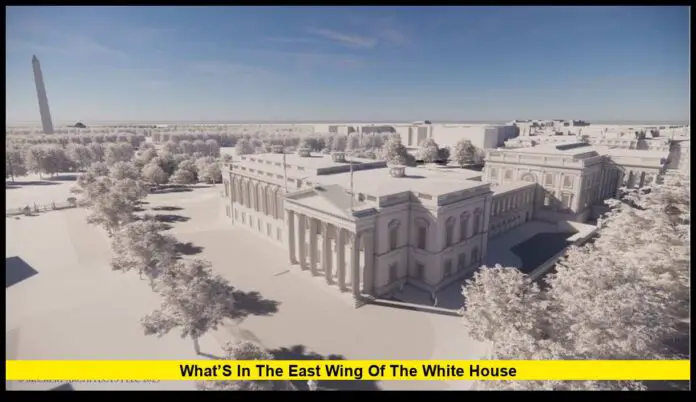
The East Wing of the White House has recently become the focal point of major construction and internal reorganization. As of October 21, 2025, this historic section of the Executive Residence is undergoing one of its most significant transformations in modern history. Demolition work began on October 20 to remove portions of the East Wing to make way for a massive new ballroom project announced earlier this year.
Table of Contents
Historical Role of the East Wing
The East Wing was first added to the White House during the early 20th century as part of Theodore Roosevelt’s renovations in 1902. Originally, it served primarily as an entrance area for guests and staff.
In 1942, the structure was expanded to conceal the underground Presidential Emergency Operations Center (PEOC), a secure bunker built during World War II. Since then, the East Wing has grown into a vital part of the White House complex, balancing both administrative and ceremonial roles.
Over time, First Ladies have used the East Wing as the base of operations for their offices and initiatives. The space has evolved to include not just offices but also a visitors’ entrance, staff rooms, and the family theater.
Current Functions Prior to Redevelopment
Before the latest round of construction began, the East Wing served several important functions within the White House:
- Office of the First Lady – This area has traditionally housed the First Lady and her staff, managing public outreach, social initiatives, and ceremonial events.
- Office of the White House Social Secretary – Responsible for organizing official events, state dinners, and receptions.
- Graphics and Calligraphy Office – Produces invitations, menus, and official documents for White House events.
- Visitor Entrance and Lobby – The East Wing serves as the entry point for most White House tours and official visitors.
- White House Family Theater – A small, private theater used by the First Family for films and special screenings.
- East Colonnade – A walkway connecting the East Wing to the Executive Residence, used by staff and visitors.
In short, the East Wing has functioned as both a working space and a welcoming area, bridging public access and executive operations.
What’s Happening in 2025: Major Redevelopment Underway
In mid-2025, the White House announced a major overhaul of the East Wing to construct a 90,000-square-foot ballroom. The project, estimated to cost approximately $250 million, is aimed at expanding the building’s capacity to host large-scale official events.
On October 20, 2025, demolition began on portions of the East Wing’s façade. The construction represents the first large-scale structural alteration of the White House since the Truman renovation in the late 1940s.
The new ballroom is designed to accommodate between 650 and 1,000 guests, making it one of the largest interior event spaces in Washington, D.C. It will provide a permanent venue for state dinners, diplomatic receptions, and major cultural gatherings.
While the new ballroom is being constructed, several offices that traditionally operate out of the East Wing — including the First Lady’s staff and social offices — are being temporarily relocated to other parts of the White House complex and nearby federal buildings.
Why the White House Is Expanding the East Wing
The renovation is intended to address long-standing logistical limitations. The current East Room — historically used for receptions and state dinners — can only hold about 200 people comfortably. For larger gatherings, the White House has often relied on temporary tents erected on the South Lawn, which are subject to weather conditions and security challenges.
The new ballroom will offer:
- Enhanced hosting capabilities for international delegations and cultural events.
- A secure, weather-proofed indoor setting for large receptions.
- Advanced lighting, sound, and broadcast infrastructure to accommodate global media coverage.
- A design consistent with the White House’s neoclassical architectural style.
What Will Stay and What Will Change in the East Wing
While much of the East Wing’s structure is being redesigned, several of its core functions will remain intact or be modernized.
Features likely to remain:
- Visitor lobby and main entrance, though temporarily relocated during construction.
- Offices associated with the First Lady and social staff, which will return after modernization.
- Graphics and Calligraphy Office, expected to receive new workspaces.
- Access to the Presidential Emergency Operations Center (PEOC), which remains secured beneath the East Wing.
Features undergoing significant change:
- The East Wing’s façade and portions of the internal office layout are being demolished and rebuilt.
- The ballroom will occupy a large section of the new structure.
- Certain administrative and visitor functions will be consolidated or relocated to new areas once the renovation is complete.
Timeline of the East Wing Project (As of October 2025)
| Date | Event | Status |
|---|---|---|
| July 31, 2025 | Announcement of East Wing ballroom project | Completed |
| September 2025 | Site preparation and security clearance | Ongoing |
| October 20, 2025 | Demolition of East Wing façade begins | Active |
| Late 2026 | Structural framework and exterior rebuilding | Upcoming |
| 2027–2028 | Interior construction and design installations | Planned |
| January 2029 | Target completion before end of Trump term | Projected |
Impact of the Renovation on White House Operations
The East Wing project has temporarily altered day-to-day operations at the White House:
- Visitor Access – Public tours are currently limited, with new entry points established near the Treasury building while construction continues.
- First Lady’s Office – Staff have relocated temporarily to the Eisenhower Executive Office Building.
- Event Planning – Large events are being held off-site or in the White House Rose Garden until the ballroom is completed.
- Security Adjustments – The Secret Service has expanded perimeter monitoring and rerouted internal corridors to maintain safety during the construction phase.
Despite the disruption, the modernization is expected to enhance the White House’s long-term functionality and prestige.
Architectural and Historical Considerations
The East Wing is not only an operational hub but also a historic structure protected by preservation guidelines. Every change to the White House exterior must align with federal heritage standards to ensure that the building’s neoclassical style remains intact.
Architects and preservation specialists are overseeing the redesign to ensure that the new ballroom harmonizes with the original structure’s appearance. The materials used — including white limestone, marble, and reinforced steel — are intended to echo the White House’s original 19th-century aesthetic while meeting modern safety standards.
Public and Political Reactions
The decision to redevelop the East Wing has generated mixed reactions. Supporters of the project argue that the modernization reflects America’s evolving global role and allows the White House to host world leaders in a venue that matches the grandeur of other nations’ state facilities.
Critics, however, question the timing and necessity of such a large project, especially given the cost and temporary loss of historic office space. Some preservationists have voiced concern that the East Wing’s character could be altered by large-scale structural changes.
Nevertheless, public opinion remains divided, with many Americans expressing curiosity about the design and potential impact of the new ballroom on White House traditions.
What the East Wing Means for the Future of the White House
The modernization marks a turning point in the White House’s history. Once complete, the new East Wing will not only house a state-of-the-art ballroom but will also include updated offices, enhanced security systems, and more efficient layouts for staff operations.
This renovation underscores the balance between preserving national heritage and adapting to modern demands. The East Wing — long associated with the First Lady’s initiatives and public engagement — will now also serve as a symbol of the White House’s ability to evolve while maintaining its historical identity.
In Summary
So, what’s in the East Wing of the White House? Traditionally, it has served as the hub for the First Lady’s staff, the Social Secretary’s office, visitor access, and other ceremonial functions. As of 2025, however, it is undergoing a historic transformation — with a new 90,000-square-foot ballroom reshaping both its purpose and appearance. Once complete, the East Wing will continue to serve as a bridge between America’s political power and its public image, combining tradition with 21st-century innovation.
What are your thoughts on the changes to the East Wing? Share your opinion below and stay informed as this historic renovation continues.

