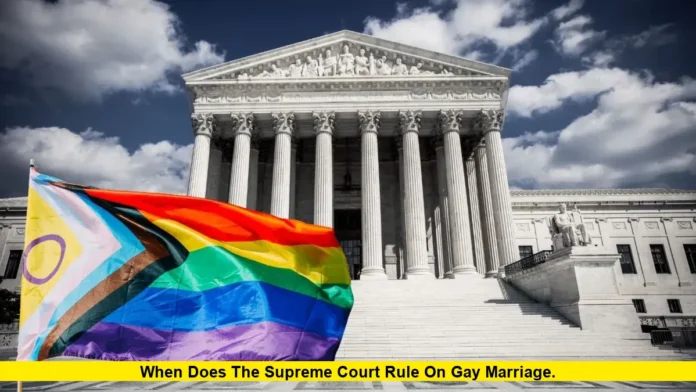
The question “when does the Supreme Court rule on gay marriage” continues to capture national attention as Americans watch how the highest court in the country handles issues surrounding same-sex marriage and equality. Although the Supreme Court’s landmark decision in 2015 legalized gay marriage nationwide, the topic has resurfaced in 2025 amid political debate, legal petitions, and renewed interest in whether the Court might ever reconsider its ruling.
This article explores the full history, legal background, and current updates surrounding the Supreme Court’s role in gay marriage — from the 2015 Obergefell v. Hodges decision to the latest developments in 2025.
Table of Contents
The 2015 Decision: A Defining Moment in U.S. Civil Rights
When Americans ask, “when does the Supreme Court rule on gay marriage?”, the answer begins with June 26, 2015. On that day, the Supreme Court issued its historic decision in Obergefell v. Hodges, recognizing same-sex marriage as a constitutional right protected under the Fourteenth Amendment.
The Court’s 5–4 decision fundamentally changed the legal landscape across the country. Before Obergefell, same-sex marriage was banned in several states, leaving couples without equal access to legal protections such as inheritance rights, spousal benefits, and parental recognition. The ruling ensured that:
- Same-sex couples have the right to marry in all 50 states.
- States must recognize same-sex marriages performed elsewhere.
- Denying marriage rights violates the U.S. Constitution’s Equal Protection and Due Process Clauses.
Justice Anthony Kennedy, writing for the majority, stated that “no union is more profound than marriage,” emphasizing the dignity and equality of all couples under the law. This decision was not only about marriage licenses — it was about the recognition of love and commitment in the eyes of both the government and society.
Life After Obergefell: National Legal and Social Impact
The years following the Supreme Court’s ruling brought sweeping changes for LGBTQ+ Americans. Same-sex couples gained the right to marry, adopt children jointly, and receive benefits such as Social Security, health insurance, and survivor pensions.
Culturally, the decision was celebrated as one of the most significant civil rights victories of the 21st century. Marriage ceremonies took place across the country, and rainbow flags filled city halls, public squares, and social media feeds.
However, even with legal recognition, the journey toward full equality was far from complete. Challenges related to discrimination, religious liberty exemptions, and parental rights continued to emerge in both federal and state courts. These ongoing legal battles laid the groundwork for renewed questions about whether the Supreme Court might be asked to revisit its 2015 decision.
The Present Question: Will the Supreme Court Rule on Gay Marriage Again?
As of November 2025, the Supreme Court has not issued a new ruling on gay marriage. The 2015 decision remains the standing law of the land.
However, a recent legal petition filed earlier this year has reignited public debate. The petition requests that the Court reconsider Obergefell v. Hodges, claiming the original decision infringed on states’ rights and religious freedom.
The petition’s path through the Court will determine if and when the Supreme Court might rule on gay marriage again. If the Court declines to hear the case, the 2015 ruling remains undisturbed. If it agrees to hear it, oral arguments would likely be scheduled for 2026, with a potential ruling coming by the end of that term — typically around June.
Currently, the Court has not confirmed whether it will take up the case. Legal experts believe that while some justices may be open to reviewing aspects of the 2015 ruling, a complete reversal is unlikely given the significant legal and societal implications.
How the Supreme Court Decides What to Hear
Understanding how the Court operates is key to answering when does the Supreme Court rule on gay marriage.
The Supreme Court receives thousands of petitions every year but only agrees to hear a small percentage of them. The justices meet privately in what’s known as a “conference” to decide which cases warrant review. For a case to move forward, at least four of the nine justices must vote in favor of granting a hearing.
Once accepted, the Court schedules oral arguments, during which both sides present their positions. After deliberations, the Court issues its written decision — often released at the end of its annual term in late June.
Therefore, even if the Court agrees to revisit gay marriage in the future, no new ruling could be expected before mid-2026 at the earliest.
Federal Safeguards: The Respect for Marriage Act
Since the Obergefell decision, lawmakers have taken steps to secure marriage rights at the federal level. In 2022, Congress passed and President Biden signed the Respect for Marriage Act, ensuring that the federal government and all states must recognize marriages performed in any U.S. jurisdiction, regardless of the sex or race of the spouses.
This act was designed to safeguard marriage equality in case the Supreme Court ever overturns Obergefell. It means that even if the Court revisits the issue, federal recognition of same-sex marriages would remain intact.
However, the Respect for Marriage Act does not force states to issue marriage licenses if Obergefell were overturned — it only guarantees recognition of existing marriages performed elsewhere. In such a scenario, states with old bans on same-sex marriage might attempt to reinstate them, creating a patchwork of legal recognition similar to what existed before 2015.
Public Opinion and the Social Climate in 2025
The national mood around same-sex marriage has evolved dramatically since the 1990s. In 2025, polls consistently show that over 70% of Americans support marriage equality. Support crosses political, generational, and geographic boundaries, marking a striking cultural shift from just two decades ago.
Younger Americans overwhelmingly favor marriage equality, viewing it as a fundamental civil right rather than a partisan issue. Faith communities are also increasingly divided, with some denominations supporting same-sex unions while others maintain traditional definitions of marriage.
While opposition remains in certain circles, the broader U.S. consensus leans firmly toward preserving the rights established under Obergefell. This strong public backing makes it politically and socially challenging for the Supreme Court to revisit — let alone reverse — its earlier ruling.
Potential Outcomes: What Could Happen Next
If the Supreme Court decides to hear a new same-sex marriage case, several scenarios could unfold:
- The Court Declines Review:
The petition to revisit Obergefell is denied. The 2015 ruling remains law, and marriage equality continues unchanged. - The Court Reviews but Upholds Obergefell:
The Court agrees to review the case but reaffirms its earlier decision, reinforcing marriage equality as settled law. - The Court Narrows the Scope:
The Court might issue a limited decision focused on religious or state-level exemptions without overturning Obergefell entirely. - The Court Overturns Obergefell:
This is the most extreme and least likely outcome. It would return the power to define marriage to individual states, creating potential confusion and legal conflict.
Timeline of Major Events in U.S. Marriage Equality
| Year | Event |
|---|---|
| 2004 | Massachusetts becomes the first state to legalize same-sex marriage. |
| 2013 | Supreme Court strikes down the Defense of Marriage Act (DOMA), expanding federal recognition for same-sex marriages. |
| 2015 | Obergefell v. Hodges legalizes same-sex marriage nationwide. |
| 2022 | Respect for Marriage Act signed into federal law. |
| 2025 | Petition filed urging the Supreme Court to revisit the Obergefell decision. |
Why the Question Still Matters
Even though same-sex marriage is currently legal across the United States, the question of when does the Supreme Court rule on gay marriage continues to matter deeply — both legally and symbolically.
It reflects ongoing tensions between personal rights and state authority, between freedom of religion and freedom from discrimination. More importantly, it underscores the reality that no right is ever truly guaranteed unless it is continuously protected.
The Supreme Court’s decisions carry lasting influence, shaping not only legal standards but also the national conversation about equality, justice, and human dignity. Whether the Court chooses to revisit marriage rights or not, its role in defining the boundaries of liberty remains central to American democracy.
Looking Ahead: The Future of Marriage Equality in America
While the 2015 ruling remains a landmark victory, the continued focus on when the Supreme Court rules on gay marriage reminds us that legal progress requires vigilance. Advocacy organizations, legal scholars, and ordinary citizens are closely monitoring the Court’s docket to see if any new same-sex marriage cases are accepted for review.
At the same time, local and federal governments are reinforcing legal protections through legislation and policy to ensure marriage equality cannot be easily undone.
For now, same-sex marriage remains fully recognized and protected nationwide. But as American legal history shows, civil rights victories must be defended continuously — both in the courtroom and in public discourse.
In summary, the answer to “when does the Supreme Court rule on gay marriage” is that the Court has already ruled — in 2015 — and that decision remains binding today. While petitions to revisit the issue have surfaced, no new ruling date has been set. Until further notice, marriage equality stands as the law of the land, defining a decade of progress in American civil rights.
What are your thoughts on whether the Supreme Court should revisit this historic decision? Share your perspective below and stay informed on future updates about marriage equality in the United States.

