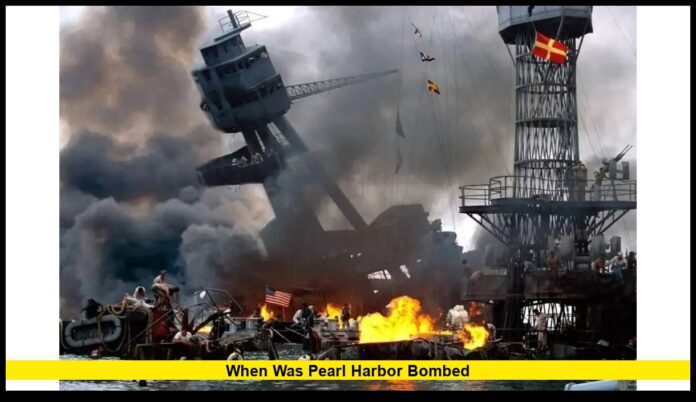
When was Pearl Harbor bombed? The United States naval base at Pearl Harbor, Hawaii, was bombed on December 7, 1941, by the Imperial Japanese Navy Air Service. The surprise attack began just before 8 a.m. local time and lasted around 90 minutes. It remains one of the most pivotal moments in U.S. history, directly leading to America’s entry into World War II.
As of December 2025, the nation marks 84 years since the attack, continuing to honor the lives lost and the bravery of those who defended their country on that fateful morning.
Table of Contents
The Morning of December 7, 1941
That Sunday morning began like any other day for servicemen stationed at Pearl Harbor. The base, located on the island of Oahu, was home to the U.S. Pacific Fleet. Many sailors were just starting their day when the first wave of Japanese aircraft appeared over the harbor shortly before 8 a.m.
At 7:55 a.m., explosions echoed across the island as bombs rained down on battleships, airfields, and hangars. The assault was a coordinated strike designed to cripple America’s naval power in the Pacific.
Within minutes, several key battleships were engulfed in flames. The USS Arizona, struck by a massive bomb that ignited its ammunition stores, exploded and sank almost instantly, killing 1,177 crew members. The USS Oklahoma capsized after taking multiple torpedo hits, trapping hundreds of sailors inside.
By the time the attack ended less than two hours later, the devastation was immense. The U.S. had suffered 2,403 deaths and 1,178 wounded. More than 180 aircraft were destroyed, and 21 ships were sunk or damaged.
Why Japan Launched the Attack
The bombing of Pearl Harbor did not happen without tension. The roots of the attack traced back to years of rising conflict between the United States and Japan.
By 1941, Japan was expanding its empire across East Asia and the Pacific, invading territories to secure natural resources like oil and rubber. The U.S. strongly opposed this aggression and placed economic sanctions on Japan, including freezing its assets and cutting off oil supplies.
Japan’s leaders viewed these sanctions as a threat to their survival. To secure access to resources and reduce American interference, Japan’s military command planned a preemptive strike to destroy the U.S. Pacific Fleet. Their hope was that crippling America’s naval power would prevent U.S. forces from stopping Japan’s expansion.
The attack was meticulously planned by Admiral Isoroku Yamamoto, who believed that a surprise assault would buy Japan time to dominate the Pacific. However, instead of weakening the United States, the bombing unified the nation like never before.
A Timeline of the Attack
| Time (HST) | Event |
|---|---|
| 6:00 a.m. | Japanese aircraft carriers launch over 350 planes toward Hawaii. |
| 7:55 a.m. | The first wave strikes Pearl Harbor. Torpedo bombers target battleships at Ford Island. |
| 8:00 a.m. | The USS Arizona is hit, exploding with devastating force. |
| 8:10 a.m. | The USS Oklahoma capsizes after multiple torpedo strikes. |
| 8:50 a.m. | The second wave of Japanese planes attacks airfields and remaining naval targets. |
| 9:45 a.m. | The last Japanese aircraft depart; the assault is over. |
| 10:00 a.m. | Smoke and flames rise over Pearl Harbor as rescue efforts begin. |
Despite the destruction, key American aircraft carriers — including the USS Enterprise, USS Lexington, and USS Saratoga — were not in port that morning. Their absence would prove critical in the months that followed, allowing the U.S. Navy to rebuild and retaliate.
The Immediate Aftermath
In the hours following the attack, Pearl Harbor was chaos. Hospitals and makeshift triage centers overflowed with wounded sailors and civilians. Crews worked tirelessly to rescue trapped personnel from sunken ships.
That same day, military bases across Hawaii went on high alert, preparing for the possibility of a land invasion. However, Japan’s forces quickly retreated, having completed their mission.
By the next morning, December 8, 1941, President Franklin D. Roosevelt delivered his famous address to Congress, declaring December 7 “a date which will live in infamy.” Congress swiftly approved a declaration of war against Japan, formally bringing the United States into World War II.
The Cost of the Attack
The human toll of Pearl Harbor was staggering.
- 2,403 Americans were killed.
- 1,178 were wounded.
- 21 naval vessels were damaged or sunk.
- 188 aircraft were destroyed on the ground.
Among the dead were both military personnel and civilians. Families across the U.S. awoke to radio broadcasts describing the attack, many not realizing until days later whether their loved ones had survived.
The assault not only marked a national tragedy but also a turning point that would change the direction of world history.
The USS Arizona and Its Legacy
Of all the ships attacked, none became more symbolic than the USS Arizona. The massive explosion that sank the vessel remains one of the most haunting moments of the attack. The ship’s wreckage still rests at the bottom of Pearl Harbor, serving as the final resting place for more than 900 sailors.
Today, the USS Arizona Memorial stands above the remains of the battleship. Visitors can look down into the water, where the ship still leaks small drops of oil — often called “the black tears of the Arizona.” The memorial honors all who lost their lives in the attack and has become one of America’s most sacred sites.
How the United States Responded
The attack on Pearl Harbor transformed the United States overnight. Once divided over involvement in the war, the nation unified with unprecedented determination.
Factories began producing ships, aircraft, and weapons around the clock. Young men enlisted in record numbers, while women entered the workforce in support roles through wartime industries.
In less than a year, the U.S. Navy rebounded with remarkable speed. Key victories followed, including the Battle of Midway in June 1942, where American forces sank four Japanese aircraft carriers — a turning point in the Pacific War.
The strength of the U.S. response demonstrated the nation’s resilience and set the stage for eventual Allied victory in 1945.
Pearl Harbor Today: Remembering 84 Years Later
Every year on December 7, Americans observe National Pearl Harbor Remembrance Day. Ceremonies are held across the country, with the largest at the Pearl Harbor National Memorial in Hawaii.
The event typically includes:
- A moment of silence at 7:55 a.m. — the exact time the attack began.
- Flyovers by U.S. military aircraft.
- Wreath-laying ceremonies to honor those lost.
- Speeches by veterans and officials reflecting on the lessons of the past.
Although the number of surviving veterans has grown smaller each year, their stories continue to inspire new generations. In 2025, the 84th anniversary ceremony included both in-person and virtual tributes, ensuring Americans nationwide could take part in honoring the fallen.
Why Pearl Harbor Still Matters
The bombing of Pearl Harbor was not just a military event — it was a defining moment in America’s identity. It reshaped U.S. foreign policy, propelled the nation into global leadership, and underscored the importance of vigilance and preparedness.
For many Americans, Pearl Harbor serves as a lasting reminder of unity and courage in the face of adversity. The attack brought unimaginable loss, yet it also revealed the country’s ability to rise, rebuild, and fight for freedom.
Even today, the site stands as a testament to sacrifice and national strength — a solemn reminder that peace often comes at a great cost.
Pearl Harbor Facts at a Glance
- Date of Attack: December 7, 1941
- Location: Pearl Harbor, Oahu, Hawaii
- Casualties: 2,403 killed, 1,178 wounded
- Ships Damaged/Sunk: 21
- Aircraft Destroyed: 188
- Duration of Attack: Approximately 90 minutes
- Result: U.S. entry into World War II
The Lasting Legacy of December 7
Eighty-four years later, the events of Pearl Harbor continue to echo through American culture and education. Each generation learns the significance of that morning — not only as a tragic loss but as a moment that reshaped history.
Museums, documentaries, and memorials across the nation keep the story alive. Schools still teach the lessons of courage, resilience, and unity that emerged from tragedy. For those who visit the site in Hawaii, the quiet waters of Pearl Harbor remain a place of reflection and gratitude.
Conclusion
So, when was Pearl Harbor bombed? The attack took place on December 7, 1941, a day that changed the course of U.S. and world history. Eighty-four years later, Americans continue to honor the heroes who stood in defense of freedom, ensuring that their sacrifices are never forgotten.
How do you remember the legacy of Pearl Harbor today? Share your thoughts and reflections below.

