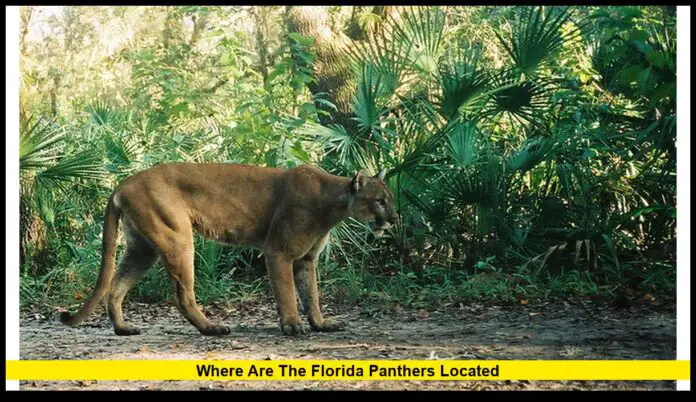
If you’ve ever asked where are the Florida panthers located, the answer lies deep in the wetlands, forests, and swamps of South Florida. As of January 2026, these rare, majestic cats live primarily in Collier, Lee, Hendry, and Miami-Dade counties, where wild terrain still offers space to roam.
Florida panthers are a subspecies of the North American cougar, known scientifically as Puma concolor coryi. Once common across the southeastern United States, they are now confined to a small portion of their original range. Despite the odds, conservation efforts over the last few decades have kept this endangered species alive — and even slowly growing.
Table of Contents
Where Florida Panthers Live in 2026
Today, the Florida panther population is centered in Southwest Florida, especially within protected wilderness areas that provide food, cover, and space to raise young.
Their main strongholds include:
- Big Cypress National Preserve (Collier County):
Stretching across 720,000 acres, this swampy wilderness is home to one of the largest concentrations of panthers. It offers a mix of pine flatwoods, prairies, and cypress forests that are ideal for hunting deer and hogs. - Florida Panther National Wildlife Refuge (Collier County):
This 26,000-acre refuge was created specifically for panther conservation. It provides essential breeding habitat and is a hub for scientific research and tracking programs. - Everglades National Park (Miami-Dade County):
Panthers occasionally roam the park’s western regions near Shark River Slough. The Everglades’ vast wetlands offer both water and cover, key for hunting and hiding. - Fakahatchee Strand Preserve State Park:
Often called the “Amazon of North America,” this preserve provides some of the densest and most secluded habitat for panthers in Florida.
These areas form the heart of the Florida panther’s range, all connected through a network of public lands and private conservation properties.
While males occasionally wander north across the Caloosahatchee River into central Florida counties like Glades and Highlands, there is still no confirmed breeding population north of the river. Conservationists hope that will change in the coming years as habitat corridors improve.
How Many Florida Panthers Are Left?
The Florida Fish and Wildlife Conservation Commission (FWC) estimates there are between 120 and 230 Florida panthers living in the wild today. This range is based on GPS tracking data, camera trap images, and genetic analysis.
That number represents a huge success compared to the 1970s, when only about 20 panthers remained. Decades of habitat protection, research, and careful breeding support have helped stabilize the species.
To monitor their health and territory, biologists fit some panthers with GPS collars that transmit real-time location data. These collars help scientists map migration routes, measure distances traveled, and detect potential risks such as road crossings.
The Importance of the Caloosahatchee River
One of the most important natural features in the panther’s story is the Caloosahatchee River, which runs from Lake Okeechobee to the Gulf of Mexico. For now, it acts as both a lifeline and a barrier.
Male panthers are strong swimmers and have been tracked crossing the river in search of new territory. However, females rarely cross, which limits the species’ ability to expand northward.
To address this, conservation groups and state officials have built wildlife underpasses and crossings beneath major highways, such as Interstate 75 (Alligator Alley) and U.S. 41 (Tamiami Trail). These structures give panthers and other wildlife safe passage, helping reconnect fragmented habitats.
What Makes South Florida Ideal for Panthers
Florida panthers thrive in areas with a mix of forest, swamp, and open prairie — landscapes that support deer, their main prey.
They also rely on:
- Dense vegetation for stalking and resting.
- Abundant freshwater sources, like creeks and wetlands.
- Minimal human disturbance, since panthers are shy and avoid populated areas.
Each adult male can control a territory of up to 200 square miles, while females typically range over about 75 square miles. This need for vast territory is why maintaining connected wildlands is critical for their survival.
Florida Panther Behavior and Lifestyle
Panthers are mostly nocturnal hunters, active during dawn, dusk, and nighttime hours. They feed mainly on white-tailed deer but will also hunt raccoons, wild hogs, and smaller animals when food is scarce.
They are solitary animals — males and females meet only for breeding, and kittens stay with their mothers for up to two years before setting out on their own.
Adult panthers can live around 10 to 12 years in the wild, though many die younger due to habitat loss and vehicle collisions.
Human–Panther Encounters in 2026
As Florida’s population grows, encounters between people and panthers occasionally happen, especially in Collier, Lee, and Hendry counties. However, panthers naturally avoid humans and are not a threat.
In 2025, the FWC verified 36 panther-related incidents involving livestock, mostly goats and calves. Residents living near panther territory are urged to take simple precautions, such as:
- Keeping pets and livestock indoors or in secure pens at night.
- Avoiding outdoor feeding of wildlife, which can attract prey and panthers.
- Reporting sightings through the Panther Sightings Database managed by the FWC.
Importantly, there have been no recorded attacks on humans by Florida panthers in modern history.
How Conservation Efforts Saved the Florida Panther
The story of the Florida panther’s survival is one of America’s greatest conservation successes.
By the early 1990s, the species was on the brink of extinction. Then, in 1995, wildlife experts introduced eight female Texas cougars into South Florida. The goal was to restore genetic diversity and reduce inbreeding problems like heart defects and kinked tails.
The plan worked. Within a decade, the population grew steadily, and healthier kittens began to appear.
Key milestones in the recovery include:
- Creation of protected lands, like the Florida Panther National Wildlife Refuge.
- Installation of wildlife crossings to prevent road deaths.
- Strict anti-poaching laws and ongoing monitoring programs.
- Public awareness campaigns, encouraging coexistence with panthers.
Thanks to these efforts, the Florida panther was pulled back from the edge of extinction — though it still faces significant challenges.
Current Threats to the Florida Panther
Despite progress, the Florida panther remains critically endangered. Its biggest threats in 2026 include:
- Vehicle Collisions
Traffic is the leading cause of death for panthers. In 2025 alone, 23 confirmed panther deaths were caused by vehicles. - Habitat Loss
Rapid urban development in Southwest Florida, especially near Naples and Fort Myers, continues to shrink their living space. - Genetic Bottlenecks
Limited range means limited genetic diversity, which can lead to health issues. - Human Encroachment
Expanding housing and infrastructure cut off vital corridors that panthers use to move safely between habitats.
Conservationists stress that protecting large, connected tracts of land remains the single most important step for ensuring the species’ future.
Why the Florida Panther Matters
The Florida panther isn’t just a symbol of the state’s wild heritage — it plays a vital ecological role. As a top predator, it helps keep populations of deer and wild hogs in check, preventing overgrazing and maintaining balance in the ecosystem.
Its survival also reflects the health of Florida’s wetlands and forests. Protecting panther habitat helps preserve clean air, water, and flood control benefits that millions of Floridians depend on.
The panther’s presence signals that parts of Florida’s natural environment still function as they should — wild, untamed, and full of life.
Tracking and Identifying a Florida Panther
Florida panthers are often recognized by their sleek, tan coats, long tails, and faint facial markings. Unlike black panthers, which don’t exist in Florida, these cats are light brown to tawny in color.
Adult males weigh between 120 and 160 pounds, while females average around 80 to 100 pounds. They measure up to seven feet long, including the tail.
Biologists track them using:
- GPS collars, which record location data several times per day.
- Camera traps, which capture images for population studies.
- DNA testing, from scat and hair samples, to confirm individual identities.
These modern tools help scientists ensure the population remains stable and healthy year after year.
The Future of the Florida Panther
Looking ahead, wildlife experts are cautiously optimistic. If habitat corridors remain protected, and safe crossings continue to expand, Florida panthers may eventually reclaim parts of Central Florida.
Projects like the Florida Wildlife Corridor Initiative aim to connect fragmented habitats statewide. These corridors would give panthers and other wildlife a safe path to migrate and find new territory.
By maintaining these connections, Florida can ensure its iconic state animal thrives for generations to come.
Key Facts About Florida Panthers
- Official state animal of Florida (designated in 1982).
- Currently only found in South Florida.
- Fewer than 230 individuals remain in the wild.
- Known for their long tails and piercing golden eyes.
- Females raise 1–4 kittens every two years.
- Primarily eat deer, raccoons, and wild hogs.
- Naturally avoid humans and are rarely seen.
In Summary
So, where are the Florida panthers located in 2026? They live mostly in Southwest Florida, within protected areas like Big Cypress National Preserve, the Florida Panther National Wildlife Refuge, and parts of the Everglades.
Though their range is small, their survival story stands as proof of what’s possible when conservation, science, and community come together.
If you’re lucky enough to visit South Florida’s wild lands, keep your eyes open — you might just be standing in the territory of America’s rarest big cat.

