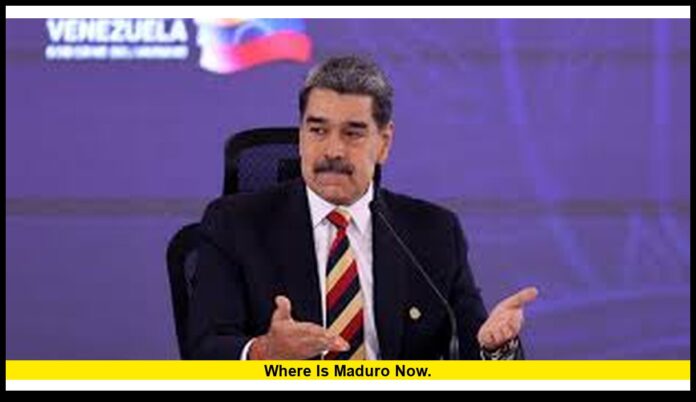
Where is Maduro now remains one of the most closely followed political questions in the world today after a dramatic escalation involving Venezuela and the United States. As of January 3, 2026, all verified and consistent updates confirm that Nicolás Maduro is no longer in Venezuela and is currently in U.S. custody, following a U.S. military operation carried out in Caracas.
This expanded report presents the most current, factual information available, focused entirely on Maduro’s confirmed whereabouts, the events that led to his removal, and the implications of his current status.
Table of Contents
Where Is Maduro Now as of Today
As of today, Nicolás Maduro is under the control of U.S. authorities and outside Venezuelan territory. He was captured during a coordinated U.S. military operation in Caracas during the early hours of January 3, 2026.
After being detained, Maduro was immediately transported out of Venezuela using U.S. military aircraft. While U.S. officials have not publicly disclosed the exact detention facility, they have confirmed that Maduro is within U.S. jurisdiction and is being held to face federal criminal charges.
There are no verified reports indicating that Maduro remains in Latin America or under Venezuelan authority.
How Maduro Was Removed From Venezuela
The events unfolded rapidly overnight and caught much of the international community off guard.
In the early morning hours, multiple explosions were reported near strategic locations in Caracas, including military-controlled areas. Shortly afterward, U.S. officials confirmed that targeted military action was underway.
During the operation:
- U.S. forces entered a secured military compound
- Maduro and his wife, Cilia Flores, were located inside the facility
- Both were detained without prolonged confrontation
- They were flown out of the country within hours
The operation effectively ended Maduro’s physical presence in Venezuela in a single night.
Maduro’s Current Legal Status
Once removed from Venezuela, Maduro’s legal status changed immediately.
He is now classified as a federal detainee under U.S. law. Long-standing U.S. indictments against him are expected to proceed, including charges related to narcotics trafficking, organized crime, and terrorism-linked offenses.
U.S. officials have confirmed that Maduro will be prosecuted in the United States. Preparations for legal proceedings are already underway, and his case is expected to move forward within the federal court system.
At this time, Maduro has not made any public statements, nor has he been granted public access.
Why His Exact Location Has Not Been Revealed
Many readers asking where is Maduro now are seeking a precise detention location. Authorities have chosen not to release that information.
This decision is based on:
- Security risks associated with high-profile detainees
- Ongoing military and intelligence considerations
- Diplomatic sensitivity involving multiple governments
What remains confirmed is that Maduro is outside Venezuela, under U.S. control, and unable to exercise political authority.
Immediate Impact Inside Venezuela
Maduro’s sudden removal triggered immediate instability inside Venezuela.
Key developments include:
- Emergency meetings among senior government officials
- Increased military presence in major cities
- Public statements condemning the operation
Despite strong rhetoric, Venezuelan authorities have not disputed the core fact that Maduro is no longer in the country. Requests for proof of his condition have been made, but no credible information suggests he remains in Venezuelan custody.
International Reaction and Diplomatic Tensions
The operation has sparked intense global reaction.
Several governments have criticized the action as a violation of sovereignty, while others have urged calm and restraint. Emergency diplomatic discussions are ongoing across the Americas and Europe.
The situation has raised broader questions about international law, intervention, and accountability of long-standing political leaders accused of serious crimes.
Why the Question “Where Is Maduro Now” Matters
The importance of knowing where Maduro is now extends far beyond Venezuela’s borders. This moment represents a historic shift in international relations, legal accountability, and geopolitical dynamics. For decades, Nicolás Maduro’s physical location—centered in Caracas—reflected not just his political authority but also his ability to influence domestic policy and regional alliances. That reality has now fundamentally changed, and the implications are both immediate and far-reaching.
One of the most significant impacts is on regional stability in Latin America. Maduro’s removal has created a power vacuum and a period of political uncertainty within Venezuela. Neighboring countries are closely watching how governance transitions, how institutions respond, and whether political tensions escalate or de-escalate. Shifts in Venezuelan leadership have long influenced diplomatic relationships across the hemisphere, and this moment could redefine those dynamics.
The situation also affects migration patterns across neighboring countries. Venezuela has experienced one of the largest mass migrations in the region’s recent history, with millions of citizens leaving due to economic hardship and political repression. Maduro’s absence may influence decisions by Venezuelans considering whether to stay, return, or continue migrating elsewhere. How neighboring nations respond to potential migration surges or changes in refugee flows remains a critical concern for regional policymakers.
Global energy markets tied to Venezuelan oil are also being impacted. For years, Venezuela’s oil production has been in decline due to political instability and infrastructure challenges. With Maduro no longer in power and international involvement increasing, markets are watching closely for changes in oil policy, production output, and how Venezuela’s energy sector might be reintegrated into global trade. Even the perception of change can influence pricing and investment decisions.
Equally important is the effect on future U.S. foreign policy in the Western Hemisphere. The removal of Maduro signals a bold and unprecedented U.S. stance toward enforcement of law and order beyond its borders and raises questions about intervention, accountability, and diplomatic strategy. This moment will likely shape U.S. engagements with other nations facing political crises, particularly where organized crime, corruption, and governance failures overlap.
For years, Maduro’s physical presence in Venezuela was symbolic of his control and the continuity of his regime. That predictability is now gone. His confirmed detention outside his home country marks not just a personal shift for Maduro, but a transformative moment in how political leadership, legal accountability, and international influence intersect in the 21st century.
This moment answers the question “where is Maduro now” with confirmed precision, but it also opens broader debates about law, sovereignty, and the future of governance in the Americas.
Confirmed Timeline of Events
- Early January 3, 2026:
U.S. military action begins in Caracas during the pre-dawn hours. Explosions and aircraft activity are reported near strategic and military-controlled areas, signaling the start of a coordinated operation targeting key government locations. - Same morning:
Nicolás Maduro and his wife, Cilia Flores, are detained by U.S. forces inside a secured military compound. The operation concludes quickly, with no verified reports of prolonged resistance or escape attempts. - Hours later:
Maduro is flown out of Venezuela aboard U.S. military transport, officially ending his physical presence in the country. His removal marks the first confirmed instance of a sitting Venezuelan president being taken out of the nation by foreign forces. - Later that day:
U.S. officials publicly confirm that Maduro is under federal jurisdiction and will face criminal charges in the United States, shifting the situation from a military operation to a legal and judicial process.
This timeline provides a clear and factual answer to where is Maduro now: Nicolás Maduro is in U.S. custody, outside Venezuela, and under federal legal authority as of today.
What Happens Next
While many operational and legal details remain classified, several outcomes are already clear and continue to shape developments surrounding Nicolás Maduro’s status.
Maduro no longer holds power within Venezuela. His removal from the country has effectively ended his ability to govern, issue directives, or influence state institutions. Control of government functions now rests with remaining officials inside Venezuela, creating a leadership vacuum and internal uncertainty.
U.S. legal proceedings are expected to move forward. American authorities have confirmed that Maduro is being held under federal jurisdiction and will face prosecution related to long-standing criminal allegations. Legal preparation is underway, and the case is expected to proceed through the U.S. judicial system rather than diplomatic channels.
Venezuela faces an uncertain political transition. With Maduro absent, questions remain about governance, constitutional authority, and internal stability. Competing political factions and institutional leaders are navigating a rapidly changing power structure without a clear roadmap.
International pressure and diplomatic negotiations continue. Governments across the Americas and beyond are responding to the situation through emergency meetings, formal statements, and diplomatic engagement. The event has intensified global debate over sovereignty, intervention, and accountability.
At this time, no verified information suggests Maduro will return to Venezuela in the near future. U.S. officials have made no indication of release or transfer, and Maduro remains under American control, marking a decisive break from his years of rule inside the country.
Clear and Final Answer
To state it clearly and accurately:
Where is Maduro now?
Nicolás Maduro is in U.S. custody, outside Venezuela, under federal legal authority, following his capture during a U.S. military operation in Caracas on January 3, 2026. After being detained alongside his wife, Cilia Flores, Maduro was immediately removed from Venezuelan territory aboard U.S. military transport and placed under American control. U.S. officials have confirmed that he is being held for federal prosecution related to long-standing criminal charges, including narcotics trafficking and terrorism-linked offenses. His exact detention location has not been publicly disclosed for security reasons, but authorities have stated he is within U.S. jurisdiction and no longer able to exercise political authority or communicate publicly. Venezuelan officials continue to dispute the legality of the operation, while international reactions unfold, yet no verified information contradicts the confirmed reality that Maduro remains outside Venezuela and in U.S. custody. This remains his confirmed status as of today.
This remains his confirmed status as of today.
This historic moment continues to reshape regional and global politics. Share your thoughts below and stay connected as new verified updates emerge.

