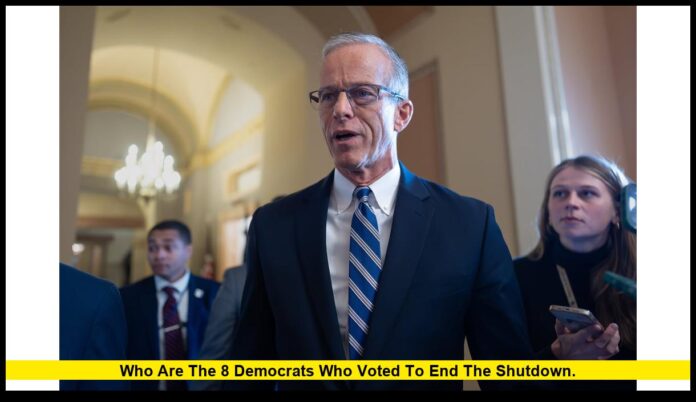
The question on everyone’s mind this week has been simple yet politically charged: who are the 8 Democrats who voted to end the shutdown? After weeks of halted government services, unpaid federal workers, and mounting pressure from the public, a handful of Democratic senators crossed party lines to bring the stalemate to an end. Their decision has not only reshaped the dynamics in Washington but also revealed deep divides within the Democratic Party itself.
Table of Contents
A Divisive Vote That Reopened Washington
The U.S. government shutdown stretched beyond 40 days—one of the longest in modern history. Federal offices were shuttered, air travel slowed, and millions of Americans dependent on federal programs like food assistance and health subsidies faced uncertainty.
Then, in a dramatic late-night session, the Senate held a crucial vote to advance a bipartisan funding measure that would reopen the government. The bill passed 60–40, thanks to eight Democrats who broke ranks and voted alongside Republicans. Their decision was both pragmatic and controversial—ending a painful standoff but drawing criticism from progressives who believed the compromise gave up too much.
List of the 8 Democrats Who Voted to End the Shutdown
The eight senators who sided with Republicans in the decisive vote were:
- Catherine Cortez Masto (Nevada)
- Jacky Rosen (Nevada)
- Maggie Hassan (New Hampshire)
- Jeanne Shaheen (New Hampshire)
- Tim Kaine (Virginia)
- John Fetterman (Pennsylvania)
- Dick Durbin (Illinois)
- Angus King (Maine, Independent who caucuses with Democrats)
These names now stand at the center of a national debate over political courage, compromise, and party loyalty.
Why These Senators Voted to End the Shutdown
Each of the eight senators had their own reasons—but they shared one belief: the shutdown had gone on too long and was hurting too many Americans.
1. Mounting Pressure from Constituents
In their home states, the effects of the shutdown were devastating. Federal workers in Virginia missed paychecks. Families in Nevada saw food assistance programs paused. Small businesses in Pennsylvania and New Hampshire reported major slowdowns.
Many senators reported being inundated with calls and emails from constituents urging them to act—no matter the political cost.
2. Protecting Federal Workers and Essential Services
Senators Tim Kaine and John Fetterman were particularly vocal about the toll on federal employees. They argued that government workers and their families should not be used as leverage in political negotiations.
The funding deal that they supported ensured:
- Immediate back pay for furloughed employees.
- Reinstatement for federal workers who were laid off during the shutdown.
- Temporary funding through January 2026 to stabilize operations.
3. Balancing Policy Goals with Real-World Harm
Democrats had pushed to tie the reopening of the government to guarantees of extending Affordable Care Act (ACA) subsidies. However, negotiations stalled as Republicans resisted linking health policy to funding.
For senators like Jeanne Shaheen and Maggie Hassan, the choice was difficult. They wanted health-care protections but believed that continued gridlock would only deepen economic pain. Their votes reflected a willingness to secure a short-term reopening while continuing to push for ACA protections in a separate bill.
4. Political Pragmatism and Swing-State Reality
Several of the eight senators come from politically divided or moderate states. Catherine Cortez Masto and Jacky Rosen in Nevada, for instance, face electorates that value bipartisan action. By supporting the deal, they positioned themselves as problem-solvers rather than partisans.
Similarly, Angus King, an independent from Maine, emphasized the need for “responsible governance over political theater.”
Inside the Senate Chamber: A Night of Tense Debate
As the vote approached, emotions in the Senate chamber ran high. Party leaders urged unity, while moderates pleaded for action. When the final tally appeared—60 votes in favor—the chamber erupted in mixed reactions: relief from some, outrage from others.
Several progressive Democrats condemned the decision, arguing that the compromise failed to secure concrete protections for health care and social assistance programs. Others, however, applauded the move as a necessary step toward restoring stability.
The eight senators stood by their choice, issuing statements that prioritized “the American people over politics.”
The Fallout Within the Democratic Party
The aftermath of the vote has been anything but calm.
A Party Divided
Progressive Democrats quickly voiced frustration, accusing the eight senators of undermining the party’s bargaining power. Some advocacy groups even hinted at potential primary challenges in future elections.
On the other hand, moderate Democrats and independents praised the decision as an act of leadership that put national interests above partisan fighting.
Leadership Under Pressure
Party leaders now face the challenge of reconciling the divide. Senate Democrats must decide whether to double down on unity or allow room for flexibility in future negotiations.
The incident underscores a growing tension within the Democratic ranks: how to balance progressive ideals with pragmatic governance.
The Deal: What’s in the Bill That Ended the Shutdown
The legislation that moved forward included several key provisions designed to address immediate concerns:
- Reopening of federal agencies and restoration of public services.
- Guaranteed back pay for federal employees.
- Funding extension through January 2026, giving Congress time to negotiate a longer-term budget.
- Commitment to a future vote on extending ACA premium subsidies in December.
While not a sweeping victory for Democrats, the bill was widely seen as a vital relief measure for millions affected by the shutdown.
Political Implications Moving Forward
The eight Democrats’ decision could have long-term consequences—for themselves, for their party, and for the broader political landscape.
1. Impact on the 2026 Midterms
How voters interpret this vote will vary by state. In moderate regions, it may be viewed positively as evidence of bipartisan responsibility. But among progressive voters, it could spark resentment and challenges from within the party.
2. Setting a New Precedent
This vote may mark a shift in how future shutdowns are handled. Instead of prolonged standoffs, moderate lawmakers may increasingly take initiative to end gridlock—even at the cost of intra-party friction.
3. Reassessing Party Strategy
The Democratic Party may need to reevaluate its approach to high-stakes negotiations. As internal divisions become more visible, leadership will have to find ways to maintain unity while accommodating diverse state priorities.
Table: The Eight Democrats and Their Reasons for Voting “Yes”
| Senator | State | Main Reason for Supporting the Bill |
|---|---|---|
| Catherine Cortez Masto | Nevada | Prioritized relief for working families affected by the shutdown |
| Jacky Rosen | Nevada | Believed bipartisan cooperation was necessary to end economic harm |
| Maggie Hassan | New Hampshire | Responded to constituent concerns over rising costs and uncertainty |
| Jeanne Shaheen | New Hampshire | Saw the deal as the only viable path to reopen the government |
| Tim Kaine | Virginia | Advocated for federal workers and back pay guarantees |
| John Fetterman | Pennsylvania | Criticized political brinkmanship and pushed for immediate reopening |
| Dick Durbin | Illinois | Senior leader emphasizing responsibility and compromise |
| Angus King | Maine | Independent voice for pragmatic, cross-party solutions |
Public Reaction and Media Coverage
Across the nation, reactions have been mixed.
- Federal employees expressed relief and gratitude that paychecks would finally resume.
- Progressive activists lamented the deal, calling it a “missed opportunity” for stronger policy leverage.
- Independent voters largely approved, viewing the vote as a rare instance of bipartisanship.
Social media platforms lit up with debate—some praising the eight senators for their courage, others accusing them of caving too soon. The political conversation continues to evolve as new details emerge about how the final spending package will be implemented.
What Happens Next
The legislation is expected to move swiftly through the House before heading to the President’s desk for signature. Once signed, government operations will resume normal function.
Attention will now turn to December, when Congress is scheduled to revisit the issue of ACA premium tax credits—a sticking point for many Democrats who reluctantly supported the bill.
The question remains: Will the unity forged in crisis hold, or will the fault lines within the Democratic Party deepen?
A Turning Point for Democrats
The vote to end the shutdown is more than a procedural decision—it’s a defining moment in the ongoing battle over how Democrats govern in divided times. It highlights the tension between principle and practicality, between holding the line and making progress where possible.
For now, the eight senators who voted to end the shutdown stand as symbols of moderation and controversy alike. Whether they are remembered as heroes of compromise or traitors to their cause will depend on what happens next.
Conclusion
In a deeply divided Washington, these eight Democrats made a choice that put an end to weeks of paralysis. Their votes restored stability for millions of Americans but opened a new chapter in the debate over what it means to lead.
As the dust settles, one thing is clear: this decision will echo through future budget battles, campaign trails, and the very heart of the Democratic Party.
What do you think—were these senators right to cross party lines, or did they give up too much too soon? Share your thoughts below and stay informed on every update.
FAQ
Q1: Who are the 8 Democrats who voted to end the shutdown?
They are Catherine Cortez Masto, Jacky Rosen, Maggie Hassan, Jeanne Shaheen, Tim Kaine, John Fetterman, Dick Durbin, and Angus King.
Q2: Why did they vote with Republicans?
They said the prolonged shutdown was hurting their constituents and believed reopening the government was the most responsible action.
Q3: Will this affect their political careers?
Possibly. Some may face backlash from progressives, but moderates and independents may view them as pragmatic problem-solvers.

