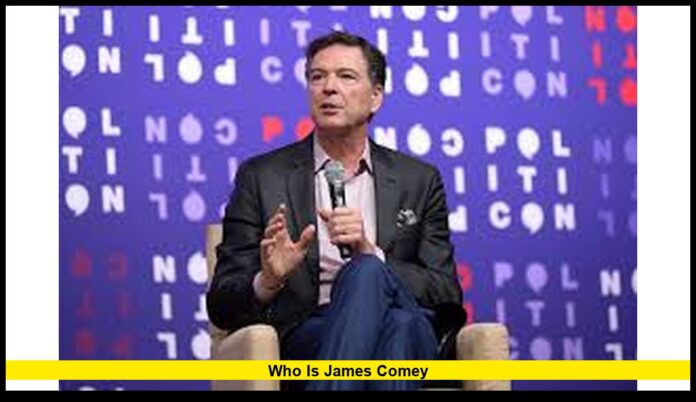
The question who is James Comey continues to capture public attention years after his tenure as FBI Director ended. As of November 2025, Comey remains one of the most recognizable figures in American political and legal circles. His time leading the FBI, his dismissal under former President Donald Trump, and his outspoken views on integrity and democracy have all cemented his place in U.S. history.
Comey’s career has spanned decades in law enforcement, public service, and education. His story is one of ambition, controversy, and a deep commitment to the rule of law — often placing him at the heart of America’s most polarizing political moments.
Table of Contents
Early Life and Education
James Brien Comey Jr. was born on December 14, 1960, in Yonkers, New York. He grew up in Allendale, New Jersey, where he attended Northern Highlands Regional High School.
Comey’s upbringing was shaped by a strong sense of public duty. After earning a bachelor’s degree in chemistry and religion from the College of William & Mary, he went on to graduate from the University of Chicago Law School in 1985. There, he developed a sharp legal mind and a commitment to justice that would guide his future career.
After law school, Comey began his legal career as a clerk for a federal judge before joining the U.S. Attorney’s Office in New York — a role that would eventually define his professional path.
Rising Through the Ranks of the Justice Department
Comey’s rise in federal law enforcement was steady and notable. As an Assistant U.S. Attorney in the Southern District of New York, he prosecuted high-profile cases involving organized crime, terrorism, and white-collar fraud. His dedication and leadership caught the attention of top officials in Washington.
In 2003, Comey was appointed U.S. Deputy Attorney General under President George W. Bush. During this time, he earned widespread respect for standing up to political pressure.
One of the most defining moments of his early career came in 2004, when he refused to approve a surveillance program he believed was illegal. His decision to resist senior White House officials, even while hospitalized Attorney General John Ashcroft was pressured to sign off on it, demonstrated Comey’s independence. That episode made him a symbol of integrity in government service.
Appointment as FBI Director
In 2013, President Barack Obama nominated Comey to serve as the 7th Director of the FBI, succeeding Robert Mueller. The Senate confirmed him with near-unanimous support, a reflection of his bipartisan credibility and reputation for fairness.
Comey began his 10-year term with a clear message: the FBI would remain independent, apolitical, and committed to truth. Under his leadership, the bureau focused on cybersecurity threats, counterterrorism, and white-collar crime.
He was widely respected both inside and outside the agency — until his actions during the 2016 presidential election thrust him into an unprecedented political storm.
The Clinton Email Investigation
Comey’s most controversial moment came in 2016 when the FBI investigated Hillary Clinton’s use of a private email server while she was Secretary of State.
In July 2016, Comey held a televised press conference announcing that while Clinton’s conduct was “extremely careless,” the FBI would not recommend criminal charges. It was an extraordinary move — and one that infuriated Democrats, who argued it broke with FBI protocol.
Then, just 11 days before the election, Comey informed Congress that the FBI had reopened the investigation after discovering new emails. The timing of the announcement, so close to Election Day, was seen by many as damaging to Clinton’s campaign.
Comey defended his actions, saying he felt obligated to update Congress and the public. Still, his decision drew intense scrutiny and marked the start of one of the most politically charged periods in FBI history.
Tensions with the Trump Administration
After Donald Trump won the presidency, Comey continued as FBI Director. But the relationship between the two quickly deteriorated.
The FBI had begun investigating Russian interference in the 2016 election and potential ties between Trump’s campaign and Russian operatives. Comey’s refusal to publicly clear the president of suspicion reportedly frustrated Trump.
Their conflict escalated after a private dinner in February 2017, where Trump allegedly asked Comey for “loyalty.” Comey declined, offering “honesty” instead — an exchange he later documented in detailed notes.
By May 2017, tensions had reached a breaking point. Trump dismissed Comey from his position, claiming it was due to his handling of the Clinton investigation. However, days later, the president stated on national television that the Russia investigation was also on his mind when making the decision.
Comey’s firing sparked political turmoil, leading to the appointment of Special Counsel Robert Mueller and a two-year investigation into Russian election interference.
After the FBI: Books, Teaching, and Public Speaking
Since his dismissal, Comey has built a second career as an author, educator, and public commentator.
His 2018 memoir, “A Higher Loyalty: Truth, Lies, and Leadership,” offered a detailed account of his years in public service and his interactions with Trump. The book became a bestseller and was later adapted into a television miniseries.
Comey has since published additional works and taught at universities, including Howard University and Columbia Law School. His lectures often focus on ethics, leadership, and public integrity — themes that have defined his professional life.
He remains an outspoken advocate for nonpartisan law enforcement and regularly comments on issues involving democracy and justice.
James Comey in 2025
As of 2025, Comey continues to participate in public discussions about the state of democracy and government accountability. While no longer involved in active politics or law enforcement, his voice remains influential in debates over leadership and transparency.
He has largely stayed out of partisan disputes but continues to emphasize the importance of ethical governance and the independence of federal institutions.
In recent interviews, Comey has reflected on his time in office with candor. He has acknowledged the consequences of his 2016 decisions while maintaining that every action he took was guided by a sense of duty.
His reputation remains complex — viewed by some as a hero of integrity and by others as a figure who changed the course of U.S. political history.
Legacy and Lasting Impact
James Comey’s career stands as one of the most significant in modern U.S. public service. His leadership, controversies, and moral stances have influenced how Americans perceive the balance between justice and politics.
His firing in 2017 reshaped the FBI’s relationship with the executive branch and became a case study in presidential authority and institutional independence. The ripple effects of that moment are still evident in ongoing debates about the limits of political power.
Comey’s story also serves as a reminder of the challenges faced by those who lead national institutions under intense political scrutiny.
Whether admired or criticized, his legacy is deeply intertwined with key moments that defined the last decade of American governance.
James Comey’s journey from prosecutor to FBI Director to outspoken advocate for ethical leadership reflects the enduring tension between politics and principle. What are your thoughts on his legacy? Share your opinions below and join the discussion.

