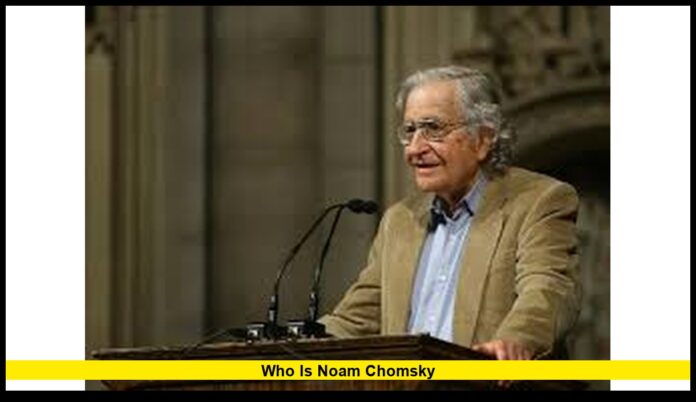
Many people continue to ask who is Noam Chomsky, especially as his influence across linguistics, philosophy, and political commentary remains strong even in 2025. Noam Chomsky, now 96 years old, is one of the most cited scholars in modern history and remains a towering figure in intellectual thought. As of December 18, 2025, he is alive, though in fragile health, residing in the United States after recovering from a serious medical condition earlier this year.
This article provides an updated, factual overview of Chomsky’s life, work, and current status — covering his academic achievements, political impact, and continued presence in public discussions.
Table of Contents
Early Life and Education
Noam Avram Chomsky was born on December 7, 1928, in Philadelphia, Pennsylvania, into a Jewish family that valued education, knowledge, and critical thinking. From childhood, he was surrounded by books and deep discussions about language, history, and society — influences that shaped both his intellectual curiosity and his lifelong passion for understanding the world.
His father, William Chomsky, was a respected Hebrew scholar and linguist who immigrated to the United States from Ukraine. He worked as a professor at Gratz College and wrote extensively about Hebrew grammar and education. His mother, Elsie Simonofsky Chomsky, was a teacher known for her warmth and commitment to social causes. Together, they created a home filled with learning, culture, and open conversation — the perfect environment for a curious young mind.
Growing up during the Great Depression and the rise of fascism in Europe, Chomsky became aware of global events early on. By the time he was ten years old, he was already reading about politics and world affairs, especially the Spanish Civil War, which left a lasting impression on his moral and political outlook.
He attended Central High School in Philadelphia, one of the city’s top public schools. While a strong student, Chomsky often preferred independent study over structured classes. He loved exploring philosophy, history, and language on his own, guided by his intense curiosity and critical approach to ideas.
After graduating high school, Chomsky enrolled at the University of Pennsylvania. Initially interested in philosophy and mathematics, he soon discovered his true calling in linguistics. It was at Penn that he met Zellig Harris, one of the most influential linguists of the time. Harris recognized Chomsky’s exceptional analytical ability and encouraged him to explore how language structure could be studied scientifically.
Under Harris’s guidance, Chomsky began questioning traditional linguistic theories that treated language as a learned behavior. He became convinced that humans are born with an innate capacity for language — an idea that would later transform the field. His exposure to philosophy under Nelson Goodman, another influential thinker, helped him connect linguistic theory to logic and human cognition.
Chomsky earned his bachelor’s degree in 1949 and his master’s in 1951, both from the University of Pennsylvania. He completed his Ph.D. in linguistics in 1955, with a dissertation titled Transformational Analysis. This early research laid the foundation for his revolutionary theory of generative grammar, which argued that the ability to form language is part of our biological makeup, not just something learned from the environment.
By his mid-twenties, Chomsky had already begun challenging long-held beliefs about how humans acquire and use language. His work introduced a new scientific approach to linguistics, one that viewed language as a window into the human mind itself.
Chomsky’s upbringing — surrounded by intellectual discussion, cultural depth, and moral awareness — deeply influenced his later work. The values he absorbed from his parents and the political consciousness he developed in his youth became inseparable from his academic career. These early years laid the foundation for a life dedicated to truth, inquiry, and the belief that knowledge should serve humanity.
Academic Career and Contributions to Linguistics
Chomsky’s groundbreaking academic career began at the Massachusetts Institute of Technology (MIT) in the 1950s, where he would remain for over 50 years. His revolutionary theory — generative grammar — transformed the study of language.
Before Chomsky, linguists largely viewed language as a learned behavior. His theory proposed that humans possess an innate ability for language, driven by what he called the “universal grammar” — a set of grammatical principles shared across all languages.
This theory fundamentally changed linguistics by suggesting that language acquisition is not merely learned from experience but is biologically prewired in the human brain.
Major Linguistic Works
Some of Chomsky’s most influential works include:
- Syntactic Structures (1957) — introduced generative grammar.
- Aspects of the Theory of Syntax (1965) — expanded his linguistic framework.
- Language and Mind (1968) — explored the connection between language and human cognition.
- The Minimalist Program (1995) — refined his linguistic theories to focus on simplicity in structure.
His ideas continue to influence modern linguistics, cognitive science, artificial intelligence, and psychology.
Chomsky’s Political Activism
Beyond linguistics, Noam Chomsky is widely recognized for his political activism. From the Vietnam War to today’s global conflicts, he has been an outspoken critic of U.S. foreign policy, corporate influence, and social inequality.
Chomsky identifies as a libertarian socialist and has long advocated for grassroots democracy, worker cooperatives, and global peace. His critiques of media manipulation and government policy have shaped political discourse for decades.
Key Political Works
Some of his most notable political writings include:
- Manufacturing Consent (1988, co-authored with Edward S. Herman) — a critical analysis of media bias.
- Hegemony or Survival (2003) — an examination of U.S. foreign dominance.
- Who Rules the World? (2016) — a reflection on global power structures in the modern age.
These works have cemented Chomsky’s reputation as a leading public intellectual, influencing activists, journalists, and academics worldwide.
Recent Health and Public Appearances (2024–2025)
As of 2025, Noam Chomsky’s health has been a subject of public concern. In June 2024, he suffered a stroke while in Brazil, where he had been spending time with his wife, Valeria Wasserman Chomsky. Following treatment and rehabilitation, he returned to the United States for ongoing medical care.
Family representatives have confirmed that while his health has been fragile, he is receiving professional support and remains under close supervision. He no longer gives live interviews or public lectures but continues to be referenced in academic discussions and online debates about politics and linguistics.
Chomsky’s last major public communication occurred in early 2024, where he commented on global conflict, climate change, and political polarization. His views continue to circulate through recorded interviews, published essays, and re-released academic works.
Legacy in Academia and Global Thought
Noam Chomsky’s intellectual legacy spans more than seven decades. He has published over 100 books and countless essays, influencing multiple academic fields, including linguistics, philosophy, political science, and communication studies.
In academia, his work laid the foundation for modern cognitive science — linking language, thought, and the structure of the mind. The Chomskyan Revolution in linguistics remains one of the most transformative developments in social science during the 20th century.
In politics, his sharp critiques of power, media, and corporate systems inspired generations of activists, journalists, and educators. His willingness to challenge authority, regardless of ideology, has earned him both admiration and controversy.
Awards and Recognition
Throughout his career, Chomsky has received numerous honors for both his academic and humanitarian work. Some of his notable recognitions include:
- Kyoto Prize in Basic Sciences (1988)
- Helmholtz Medal (1996)
- Sydney Peace Prize (2011)
- Ben Franklin Medal in Computer and Cognitive Science (1999)
- Honorary doctorates from universities around the world
He is frequently cited as one of the most quoted living scholars, with thousands of references across academic papers, news articles, and educational materials.
Chomsky’s Influence in 2025
Even as he approaches 97, Chomsky’s influence remains visible across academic and political discussions. His linguistic theories continue to shape research in artificial intelligence and machine learning, particularly in natural language processing and generative AI — technologies that rely on understanding human syntax and semantics.
In politics, his writings are regularly referenced in debates about capitalism, democracy, media transparency, and climate change. Younger generations continue to discover his ideas through digital archives, podcasts, and educational videos.
Many universities still teach Chomsky’s linguistic models as part of core curricula in linguistics and cognitive science. His dual legacy — as both a scientist and a social critic — makes him a rare intellectual figure who bridges scientific rigor with ethical inquiry.
Personal Life
Chomsky’s personal life has been marked by humility and dedication to learning. He was married to Carol Doris Schatz from 1949 until her passing in 2008. They had three children together. In 2014, he married Valeria Wasserman, a Brazilian linguist and translator.
Despite his fame, Chomsky has maintained a private lifestyle, often avoiding celebrity culture. His focus has consistently been on education, research, and advocating for social justice.
Current Status
As of December 2025, Noam Chomsky resides primarily in the United States. He continues to recover from his previous health challenges but remains a respected and enduring voice in academic and political communities. His family and colleagues emphasize that he values privacy and spends much of his time in quiet reflection and study.
Though his public appearances have become rare, his influence is stronger than ever. University lectures, academic journals, and social movements frequently reference his work, ensuring that his legacy continues to inspire new generations.
Noam Chomsky remains one of the most influential thinkers of our time — a scholar whose ideas about language, power, and society have permanently shaped the way the modern world understands communication and human thought. What are your reflections on his legacy? Share your thoughts below and join the discussion!

