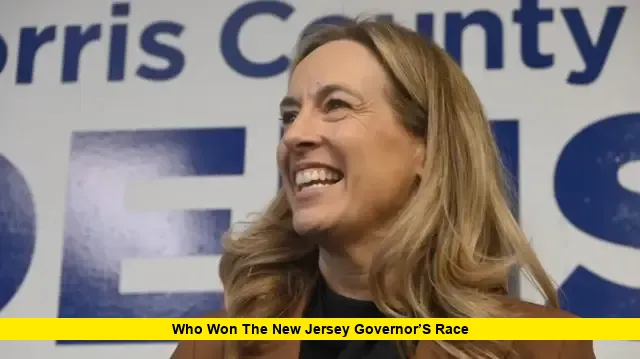
The who won the New Jersey governor’s race question was decisively answered on November 4, 2025, when Democrat Mikie Sherrill emerged victorious over Republican Jack Ciattarelli in one of the most closely watched state elections of the year. Sherrill’s victory extended the Democratic Party’s control of the governor’s office for a third consecutive term—something that hadn’t happened in New Jersey in over six decades.
Table of Contents
Mikie Sherrill’s Historic Win
Mikie Sherrill, a U.S. Representative from New Jersey’s 11th Congressional District, made history by becoming the state’s second female governor and the first woman ever to win more than 50% of the vote in a New Jersey gubernatorial election. Her background as a former Navy helicopter pilot and federal prosecutor gave her a strong foundation to project leadership and discipline throughout the campaign.
Sherrill won the race with approximately 56% of the vote, compared to 43% for Jack Ciattarelli, her Republican opponent. The turnout was one of the highest in recent state elections, reflecting deep voter engagement across suburban, urban, and coastal regions.
Her campaign focused on affordability, education, infrastructure, and pragmatic leadership, with an emphasis on unity and progress over partisanship. By appealing to moderate and independent voters, she managed to maintain strong Democratic support while also winning over key swing regions that often determine statewide outcomes.
Meet the Candidates
Mikie Sherrill – The Democratic Visionary
Sherrill’s path to the governor’s office is rooted in service. After graduating from the U.S. Naval Academy, she flew missions as a Navy pilot before serving as a federal prosecutor. Her political career began when she flipped New Jersey’s 11th District—traditionally Republican—in 2018.
In the governor’s race, Sherrill positioned herself as a centrist Democrat, promising fiscal responsibility paired with social progress. Her key proposals included:
- Expanding affordable housing options for working families.
- Reforming the state’s property tax system.
- Investing in renewable energy and transportation.
- Protecting reproductive rights and healthcare access.
- Strengthening education and workforce training programs.
Her message of practical governance resonated strongly with suburban families, educators, and professionals seeking steady leadership after years of national political turbulence.
Jack Ciattarelli – The Republican Challenger
Jack Ciattarelli, a seasoned businessman and former state Assemblyman, returned for his second run after narrowly losing the 2021 election to Phil Murphy. His campaign slogan, “Make New Jersey Affordable Again,” reflected his core promise—reducing taxes and government spending.
Ciattarelli focused on issues such as:
- Cutting property taxes and state spending.
- Easing regulations on small businesses.
- Expanding charter schools and parental choice in education.
- Strengthening public safety and police support.
While his message resonated in many South and Central Jersey communities, Ciattarelli faced challenges broadening his appeal beyond the Republican base, particularly in North Jersey suburbs where moderate voters dominate.
Breaking a 60-Year Pattern
New Jersey has long been known for alternating party control in the governor’s office—voters rarely reelect the same party three times in a row. Sherrill’s win broke that pattern, marking the first three-term Democratic streak since the early 1960s.
This victory also symbolizes a shift in the state’s political alignment. Once considered a classic “swing state,” New Jersey has leaned increasingly blue in recent cycles. However, the margin of victory—just over 13 points—shows that Republican competitiveness remains strong, especially in areas burdened by high taxes and economic strain.
Key Issues That Drove the Election
1. The Cost of Living Crisis
New Jersey’s high property taxes, housing costs, and overall affordability were the dominant themes of the election. Sherrill pledged to cap local tax hikes, streamline government spending, and expand middle-income housing development. Voters responded positively to her balanced, realistic approach.
2. Economic Opportunity
Sherrill campaigned on revitalizing New Jersey’s economy through innovation, infrastructure, and clean energy. She promised to support small businesses, attract investment in green technologies, and create jobs through transportation upgrades.
Ciattarelli countered with a more traditional economic platform focused on tax cuts and deregulation. However, Sherrill’s moderate economic tone—offering reform without disruption—appealed to a broader swath of the electorate.
3. Education and Workforce Development
Education remains a cornerstone issue in New Jersey politics. Sherrill advocated for increased funding for public schools, improved teacher pay, and expanded access to vocational training. She also emphasized preparing the state’s youth for careers in technology and renewable energy industries.
Ciattarelli, by contrast, focused on expanding charter schools and empowering parents with more control over curricula. While popular among conservatives, his message did not gain enough traction statewide.
4. Public Safety and Social Balance
Sherrill adopted a balanced approach to law enforcement—supporting police funding while emphasizing community policing and accountability. She proposed investing in mental health programs and public safety training to reduce crime rates without over-policing.
5. Healthcare and Reproductive Rights
Healthcare policy played a crucial role in mobilizing voters. Sherrill strongly defended reproductive rights and affordable healthcare access, contrasting sharply with Ciattarelli’s more conservative stance. This helped her solidify urban and suburban female voter support—key to her victory.
Regional Breakdown of the Vote
- North Jersey: Sherrill dominated in North Jersey’s populous counties such as Bergen, Essex, and Hudson, where her moderate Democratic message resonated.
- Central Jersey: This battleground area saw closer margins, but Sherrill edged out Ciattarelli by winning suburban independents concerned about property taxes.
- South Jersey: Ciattarelli performed well in traditionally conservative counties like Gloucester and Ocean but couldn’t overcome the Democratic advantage in the north.
The final result underscored how population density and suburban voter priorities shape modern New Jersey elections.
Turnout and Voter Engagement
Voter turnout in the 2025 election was notably high—one of the strongest for an off-year race in decades. This was largely driven by intense public interest in affordability issues and the high-profile nature of both candidates.
Suburban women and first-time voters played a significant role in deciding the outcome. Sherrill’s focus on family economics, childcare affordability, and women’s healthcare resonated strongly across demographics.
The Road Ahead for Governor-Elect Sherrill
As Mikie Sherrill prepares to be inaugurated in January 2026, she faces several immediate challenges and opportunities:
- Property Tax Reform: Balancing relief for homeowners while maintaining funding for education and services will be her biggest test.
- Infrastructure Investment: Sherrill plans to modernize New Jersey’s public transit system and roads to strengthen economic competitiveness.
- Housing & Affordability: Expanding access to affordable housing for middle-income families will be central to her first-year agenda.
- Economic Growth: Her administration aims to attract tech and clean-energy investments, positioning New Jersey as a leader in innovation.
- Fiscal Responsibility: Sherrill has pledged to maintain a balanced budget while improving government efficiency and transparency.
If successful, her policies could set a model for other states facing similar affordability and infrastructure challenges.
Broader Political Implications
Sherrill’s victory carries implications far beyond state borders. It underscores a broader national trend—moderate Democrats can still win in competitive states when they focus on practical solutions rather than ideological extremes.
For Republicans, the outcome raises questions about strategy. Despite strong enthusiasm from their base, the party struggled to attract independents and suburban moderates, a gap they’ll need to close before the 2026 midterms.
Politically, New Jersey’s 2025 election serves as a reminder that voters reward credibility, balance, and results-oriented leadership over divisive rhetoric.
Why This Election Matters
This election is significant not just for New Jersey, but for what it says about American politics in 2025. It reflects voter fatigue with polarization and a desire for steady, capable governance. Sherrill’s success illustrates how candidates who combine experience, empathy, and pragmatism can thrive even in uncertain political climates.
Her victory also strengthens the Democratic Party’s position in the Northeast, where a string of gubernatorial and congressional wins has reinforced its regional influence.
Final Reflection
The 2025 race for governor answered more than just the question of who won the New Jersey governor’s race—it revealed what kind of leadership the people of New Jersey want: calm, focused, and grounded in real solutions.
As Mikie Sherrill prepares to take office, all eyes will be on how she transforms campaign promises into tangible progress. What are your thoughts on her victory and the future of New Jersey politics? Share your views and stay connected for the latest developments.

