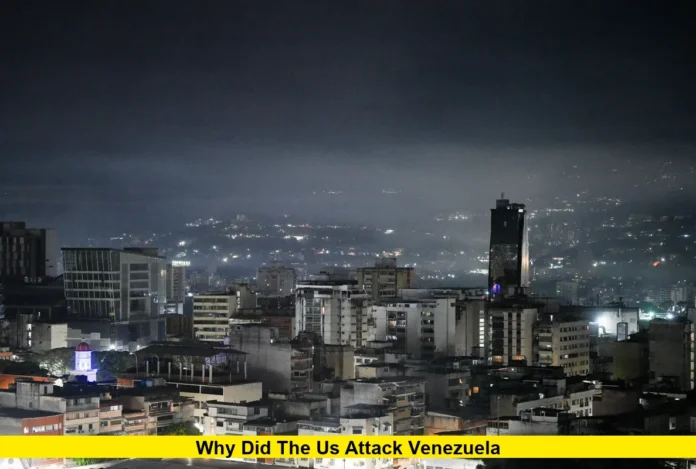
The question “why did the US attack Venezuela?” became one of the most searched and debated global topics in early 2026 after the United States carried out a sudden military operation inside Venezuelan territory and detained President Nicolás Maduro. The action marked the most dramatic escalation in U.S.–Venezuela relations in decades and sent shockwaves across Latin America and the international community.
To understand why the situation reached this point, it is necessary to look beyond the single day of military action and examine the months of mounting pressure, policy shifts, and confrontations that preceded it. What follows is a detailed timeline showing how diplomatic strain evolved into direct military intervention.
Table of Contents
Longstanding Tensions Set the Stage
U.S.–Venezuela relations had been deteriorating for years before the attack. Washington accused Caracas of undermining democratic institutions, enabling organized crime, and destabilizing the region through migration and narcotics trafficking. Venezuela, under Nicolás Maduro, consistently rejected these claims, arguing that U.S. sanctions and political pressure were responsible for the country’s economic crisis.
By 2024, Venezuela had become one of the most sanctioned countries in the world, with restrictions targeting its oil industry, financial system, and senior leadership. While military confrontation was not publicly stated as a goal, U.S. policy increasingly framed Venezuela as a regional security threat rather than a diplomatic challenge.
Early 2025: Policy Shifts and Legal Foundations
January–February 2025 marked a turning point. The U.S. administration expanded its legal authority to classify transnational criminal organizations as terrorist groups. This shift allowed drug trafficking networks allegedly operating out of Venezuela to be treated as national security threats rather than purely criminal enterprises.
U.S. officials argued that these groups were not operating independently but with the protection, or direct involvement, of high-ranking Venezuelan officials. This framing would later become central to Washington’s justification for military action.
At the same time, U.S. indictments against Nicolás Maduro and members of his inner circle remained active, accusing them of narco-terrorism and large-scale drug trafficking conspiracies.
Mid-2025: Military Presence Expands
By August 2025, U.S. military activity near Venezuela increased noticeably. The Navy deployed guided-missile destroyers and surveillance aircraft to the Caribbean and eastern Pacific. Officially, the mission was described as an enhanced counter-narcotics operation.
Venezuela condemned the deployments, calling them intimidation tactics and a violation of regional sovereignty. Still, the U.S. insisted the operations were defensive and aimed at disrupting drug routes that directly affected U.S. national security.
This period marked the transition from economic and diplomatic pressure to visible military posturing.
September–October 2025: First Strikes and Growing Controversy
In early September 2025, U.S. forces carried out their first kinetic strikes against vessels described as drug-smuggling boats linked to Venezuelan criminal organizations. Several of these strikes resulted in casualties, sparking criticism from human rights groups and members of Congress.
Throughout September and October, additional strikes followed. The Pentagon maintained that all targets were legitimate threats operating in international waters. Critics argued that the operations blurred the line between law enforcement and warfare.
Meanwhile, U.S. officials increasingly linked these maritime operations to Venezuela’s political leadership, claiming that the state itself had become a hub for organized crime.
Late 2025: Sanctions, Seizures, and Escalation
By November and December 2025, tensions escalated further. U.S. forces seized Venezuelan oil tankers accused of violating sanctions, effectively tightening an informal naval blockade. These actions directly impacted Venezuela’s remaining oil exports, a critical source of revenue.
Caracas accused Washington of economic warfare and warned that military confrontation was becoming inevitable. Diplomatic channels remained largely frozen, and regional governments expressed concern that the situation was spiraling out of control.
Despite these warnings, U.S. officials continued to emphasize that all actions were justified under counter-terrorism and national security authorities.
January 1–2, 2026: Final Signals Before the Attack
In the first days of January 2026, intelligence reports cited by U.S. officials claimed imminent threats involving drug shipments and armed groups allegedly coordinated by Venezuelan leadership. President Maduro publicly called for dialogue while simultaneously placing Venezuelan forces on heightened alert.
Behind the scenes, U.S. military assets moved into final positions. Aircraft carriers, special operations units, and surveillance platforms converged near Venezuelan airspace and coastal regions.
The stage was set for direct intervention.
January 3, 2026: The U.S. Attack on Venezuela
In the early hours of January 3, 2026, U.S. forces launched a coordinated military operation targeting strategic locations in and around Caracas. Airstrikes, electronic warfare, and ground operations were carried out with speed and precision.
Within hours, U.S. officials confirmed that President Nicolás Maduro and his wife, Cilia Flores, had been captured during the operation. They were removed from Venezuela and transferred into U.S. custody to face longstanding federal charges.
The announcement stunned the world. It marked the first time in modern history that the United States had directly captured a sitting head of state through military force.
Why Did the US Attack Venezuela?
According to the U.S. government, the answer to why did the US attack Venezuela rests on three central claims:
- National security threats, including large-scale drug trafficking operations allegedly coordinated by Venezuela’s leadership.
- Legal enforcement, tied to existing criminal indictments against Nicolás Maduro.
- Regional stability, with U.S. officials arguing that Venezuela had become a hub for transnational crime affecting the Western Hemisphere.
Critics, however, argue that the attack went far beyond law enforcement and represented a clear case of regime change. Many point to Venezuela’s vast oil reserves and its geopolitical alliances as underlying factors influencing the decision.
Immediate Aftermath and Global Reaction
Following the attack, Venezuela declared a state of emergency, while protests and demonstrations erupted across the region. The United Nations convened emergency meetings, and several governments condemned the operation as a violation of international law.
In the United States, reactions were sharply divided. Supporters praised the operation as decisive action against criminal leadership, while opponents warned it set a dangerous precedent for international relations.
Conclusion
The events of early 2026 transformed a long-running diplomatic standoff into a defining geopolitical crisis. Understanding why did the US attack Venezuela requires examining not just the dramatic military operation itself, but the year-long escalation that preceded it—marked by sanctions, naval deployments, legal strategies, and increasingly confrontational rhetoric.
As global leaders continue to debate the legality and consequences of the attack, the full impact of this unprecedented intervention is still unfolding, reshaping the future of U.S.–Latin American relations for years to come.

