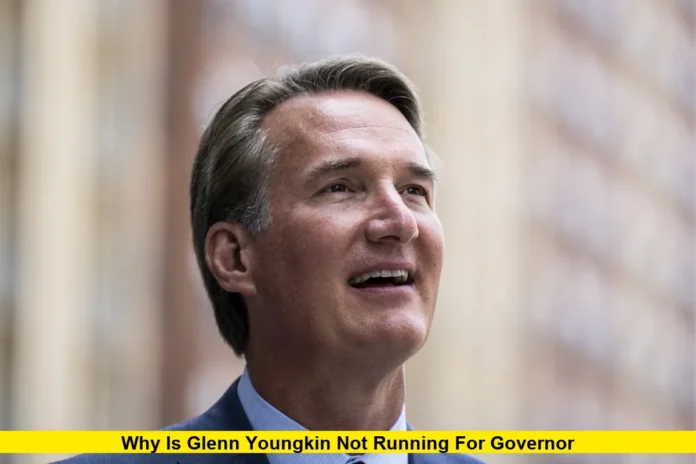
Glenn Youngkin is not running for governor in the upcoming election because he is prohibited by the state constitution from seeking immediate re-election as governor of Virginia. This restriction stems from the state’s unique term-limit rule which prevents a sitting governor from serving back to back terms.
Table of Contents
Overview of the Situation
Youngkin was elected as Virginia’s governor in the 2021 election and assumed office in January 2022. He is currently serving his four-year term. Under the Virginia Constitution, he cannot run for a second consecutive term in the 2025 gubernatorial election. That is the central answer to the question: why is Glenn Youngkin not running for governor?
What the Law Says
Virginia stands apart from most states because its governor’s office is limited to a single term in succession:
- According to the state constitution, the governor “shall be ineligible to the same office for the term next succeeding that for which he was elected.”
- This means once a Virginia governor completes their four-year term, they must step aside before they can run for the same office again (if ever).
- Several official sources note Virginia governors are barred from immediate re-election.
Because of this legal framework, Youngkin is ineligible to become a candidate in the next scheduled governor’s election in Virginia.
Why This Matters for Youngkin & the 2025 Race
Opening the Field
With Youngkin unable to run, the 2025 election becomes an open-seat race, rather than one featuring an incumbent seeking re-election. That changes the dynamics substantially:
- The governing party cannot rely on incumbency and its advantages.
- Both parties must nominate new leadership and frame fresh platforms without the governor’s re-run on the ballot.
- For the Republican Party (Youngkin’s party), the task will be to preserve the governorship without the benefit of an incumbent contest.
Youngkin’s Legacy & Strategy
Although Youngkin cannot seek the governor’s seat again immediately, the fact that he isn’t running for governor in 2025 has broader strategic implications:
- His term ends in January 2026, and during his remaining time he continues to push core policy priorities, build his profile, and set up what comes next.
- Some political watchers interpret this period as Youngkin laying groundwork for other ambitions—whether another state office (after waiting out a term) or a federal run.
- Regardless, his inability to run again impacts how he governs his final years: knowing he cannot be re-elected may influence his approach to policy, legacy building, and relations with the legislature.
Context: Why Virginia’s Term Limits Are Unique
Virginia’s restriction on consecutive terms isn’t just incidental—it has a long historical trace:
- Since at least the 1830 constitution of Virginia, governors have been barred from serving consecutive terms.
- Many experts say the one-term rule keeps governorships in Virginia in permanent transition, preventing an incumbent from carrying major weight into the next campaign.
- However, the limitation also draws criticism: while it prevents entrenchment, it may undercut continuity in long-term policy execution or reduce political accountability in a second term.
In practical terms, that means a sitting governor in Virginia governs with the knowledge that their influence ends with the term—and they will not appear on the ballot again immediately.
Breaking Down the Specifics in Youngkin’s Case
Timeline & Eligibility
- Youngkin took office in January 2022 after winning the 2021 election.
- The next gubernatorial election in Virginia is scheduled for November 2025.
- Under Virginia law, he cannot appear on the ballot in that 2025 race.
- This isn’t a personal “decision” in the typical sense; it is a legal disqualification from running again right away.
Policy & Professional Implications
- In his ongoing term, Youngkin has prioritized education reform, tax relief, workforce training and business attraction.
- As he nears the end of his tenure, his administration has intensified efforts to produce tangible results before he leaves office.
- The fact that he won’t return to the ballot may encourage either riskier policy moves (since no second campaign looms) or a focus on legacy-friendly items.
- The legislature’s relationship with the governor may shift, knowing the usual re-election leverage is missing. Some recent reports show tension between Youngkin’s appointments and legislative confirmation battles.
What the Term-Limit Rule Means For Voters and Parties
- For voters: The absence of an incumbent changes how people evaluate choices—they now pick not who defeated the governor, but a fresh face altogether.
- For parties: Both major parties must open up their candidate pipelines and craft messaging without an incumbent anchor.
- For governance: A shorter horizon and no re-election campaign may affect how bold or cautious a governor acts in the final years.
Why the Question “Why Is Glenn Youngkin Not Running for Governor” Still Matters
Because many voters may assume a sitting governor would run unless something else forces them out, clarifying that Youngkin is simply ineligible is important. It frames his exit not as a voluntary retreat but as a structural requirement of Virginia’s constitution. That distinction matters in how media, political analysts and the public interpret his current actions, his legacy, and what will come next.
Looking Ahead: What’s Next for Virginia?
With Youngkin sitting out the 2025 race, attention turns to who will succeed him and how much of his agenda will be carried forward or reversed. Key questions:
- Which candidate will capture the momentum of the governorship in Youngkin’s absence?
- How will the major parties position themselves given the open seat?
- Will Youngkin’s final initiatives leave a clear legacy, or will the next governor chart a distinctly new direction?
- What will Youngkin himself do next—run again later (after the required break), seek federal office, or pivot to other roles?
In sum, the answer to why is Glenn Youngkin not running for governor is clear and grounded in law: the Virginia constitution forbids consecutive terms, rendering him ineligible for the upcoming election. His non-candidacy is not a strategic choice in the usual sense, but a fixed consequence of the state’s governing rules.
Bold Closing Line:
Feel free to share your thoughts below or stay tuned as Virginia’s next chapter in leadership unfolds.

