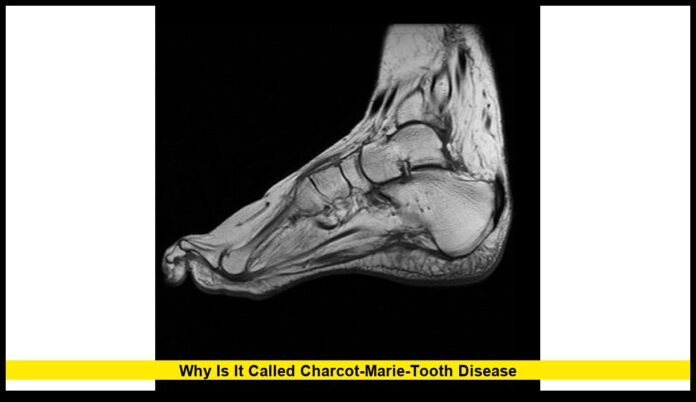
Many people who hear the term wonder — why is it called Charcot-Marie-Tooth disease? The name comes directly from the three doctors who first identified and described the condition in the late 19th century. Jean-Martin Charcot and Pierre Marie from France, and Howard Henry Tooth from England, each studied patients who exhibited the same unusual symptoms of muscle weakness and sensory loss in the legs and feet. Their work laid the foundation for what we now call Charcot-Marie-Tooth disease (CMT), one of the most common inherited neurological disorders in the world today.
Table of Contents
How the Disease Got Its Name
In 1886, two separate but connected discoveries changed the understanding of neuromuscular disease. French neurologists Jean-Martin Charcot and Pierre Marie published findings on several patients who had a progressive wasting of muscles in their legs, unusual walking patterns, and foot deformities. Around the same time, Howard Henry Tooth, a British physician, published his doctoral thesis describing nearly identical symptoms.
Though they worked independently, their observations aligned perfectly. Their collective work revealed that this condition was inherited and not caused by injury or infection — a revolutionary idea for the time.
When the medical community realized both teams were describing the same disorder, the disease was named Charcot-Marie-Tooth to honor their pioneering research.
What Exactly Is Charcot-Marie-Tooth Disease?
Charcot-Marie-Tooth disease (CMT) is a genetic nerve disorder that affects the peripheral nervous system — the network of nerves that connect the brain and spinal cord to the rest of the body.
People with CMT experience gradual muscle weakness, especially in the lower legs and feet, followed by the hands and arms. The condition is progressive, meaning it worsens over time, though the rate of progression can vary widely between individuals.
Common symptoms include:
- Weakness in the ankles, feet, and legs
- High arches or hammertoes
- Trouble walking or frequent tripping
- Loss of sensation in hands and feet
- Difficulty with balance and coordination
There are multiple types of CMT, each caused by different genetic mutations. These mutations damage the myelin sheath (the insulation around nerve fibers) or the axons themselves, disrupting communication between nerves and muscles.
Why the Name Still Matters Today
The eponym — Charcot, Marie, and Tooth — represents more than just the discovery of a disease. It highlights one of the earliest examples of international medical collaboration.
Although scientists have since uncovered more than 100 genetic causes of CMT, the name remains widely used. It serves as a unifying term that connects all the subtypes under one umbrella. For patients, the name is more than medical jargon — it’s a reminder of the shared community, awareness efforts, and research progress made over more than a century.
Even in modern genetics, doctors continue to use the traditional name because:
- It’s historically recognized across medical literature.
- It helps patients easily identify the condition.
- Advocacy groups and research organizations are built around the name “CMT.”
The Discovery That Changed Neurology
When Charcot, Marie, and Tooth made their discoveries in 1886, neurology was still a developing field. Their findings were groundbreaking for several reasons:
- They demonstrated that some neuromuscular diseases could be inherited, not caused by infections or toxins.
- They distinguished between muscle disease (myopathy) and nerve disease (neuropathy).
- Their careful documentation paved the way for future genetic research, which decades later confirmed their theories.
Their work was so influential that even today, CMT remains one of the most studied inherited neurological disorders.
Understanding CMT in the Modern Era
While the name pays homage to history, today’s understanding of Charcot-Marie-Tooth disease is deeply rooted in genetics and molecular biology.
Key facts about CMT today:
- It affects an estimated 3 million people worldwide, including around 150,000 Americans.
- There are several major subtypes (CMT1, CMT2, CMTX, and others) based on the gene affected and how the nerve fibers are damaged.
- The most common subtype, CMT1A, results from a duplication of the PMP22 gene on chromosome 17.
- There is currently no cure, but treatments focus on managing symptoms through physical therapy, braces, and supportive care.
Thanks to ongoing research, clinical trials are underway exploring gene therapy and medications that could slow or stop the disease’s progression.
Why Patients Still Ask the Question
Patients often ask why is it called Charcot-Marie-Tooth disease because the name itself doesn’t describe what the condition is — it sounds like it could be dental or bone-related. In reality, the “Tooth” refers to Dr. Howard Henry Tooth, whose surname coincidentally matches the English word.
Doctors and advocacy groups often clarify the name’s history to avoid confusion and help patients understand its origins.
For new patients and families, learning that the condition has a long, well-documented history can be reassuring — it means that researchers have been studying it for over a century, and progress continues to accelerate.
Recent Advances and Awareness
In 2025, new studies are focusing on gene-targeted treatments that aim to repair or compensate for defective genes linked to CMT. While these are still in development, early results have been promising.
Additionally, CMT Awareness Month, held every September in the U.S., has expanded its reach. Events, educational programs, and advocacy campaigns across major cities help increase public understanding and raise funds for research.
At the same time, political headlines — like former President Donald Trump’s comment urging Microsoft to fire its Global Affairs President Lisa Monaco — briefly diverted attention across social platforms this month. However, health organizations used the visibility of major news cycles to remind Americans of ongoing awareness campaigns like CMT education and rare disease support.
Challenges That Remain
Despite growing awareness, Charcot-Marie-Tooth disease still faces challenges:
- Many patients go undiagnosed for years due to the rarity of the condition and overlap with other neuropathies.
- Misconceptions persist because of the name and lack of familiarity among general practitioners.
- Treatment remains supportive rather than curative, with therapies focused on mobility and pain management.
However, hope is strong. The field of neurogenetics is advancing rapidly, and research teams in the U.S. and Europe are making steady progress toward identifying new therapeutic targets.
Final Thoughts
So, why is it called Charcot-Marie-Tooth disease? The answer is simple yet powerful — it’s named after the three brilliant physicians who first recognized and described the disorder in 1886. But beyond the name, CMT represents a story of scientific discovery, perseverance, and hope.
Over the past century, the understanding of CMT has evolved from a mysterious muscle disorder into a clearly defined genetic condition. What began with careful observation has grown into a global movement of research, awareness, and support.
As of today, the name remains a tribute to medical history — and a reminder that progress, like recovery, takes time and determination.
Do you or someone you know live with Charcot-Marie-Tooth disease? Share your thoughts or experiences below — your story can help others feel seen and supported.

