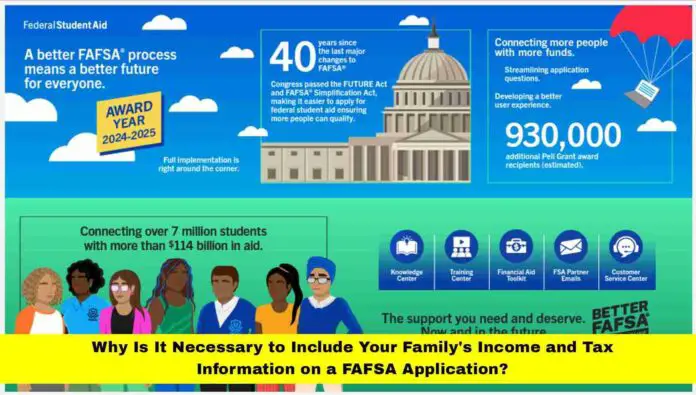
Why is it necessary to include your family’s income and tax information on a FAFSA application? This is one of the most common questions asked by students and families preparing for college financial aid in 2025. With tuition costs continuing to rise and federal aid programs updating their eligibility criteria, the role of household income and tax data in determining financial aid has never been more crucial.
The Free Application for Federal Student Aid (FAFSA) remains the primary tool used to assess a student’s financial need, and it relies heavily on accurate family income and tax records to calculate the Expected Family Contribution (EFC), soon transitioning to the Student Aid Index (SAI). Let’s dive deeper into why these details are required, how they impact financial aid decisions, and what families need to know for the current academic year.
Table of Contents
The Core Purpose of Income and Tax Data in FAFSA
The FAFSA evaluates a family’s financial strength to determine how much federal, state, and institutional aid a student may receive. Including income and tax information allows the Department of Education to create a clear financial profile.
Key Points Summary
💡 FAFSA requires family income and tax data to measure financial need fairly.
💡 These figures determine Pell Grant eligibility, subsidized loan offers, and work-study opportunities.
💡 The data ensures aid is distributed to students with the greatest need.
💡 Beginning in 2025–26, FAFSA simplifies questions but keeps income and tax details central.
💡 Using the IRS Data Retrieval Tool reduces errors and speeds up processing.
How Family Income Shapes Aid Decisions
When families ask, “Why is it necessary to include your family’s income and tax information on a FAFSA application?”, the answer lies in equity. Financial aid is not unlimited, and the government must ensure that assistance reaches students who cannot afford higher education without it.
- High-income families: Less likely to qualify for need-based grants but may still access unsubsidized loans.
- Middle-income families: Often qualify for partial aid and federal loan options.
- Low-income families: More likely to receive Pell Grants, subsidized loans, and state-based aid.
This tiered approach prevents aid from being distributed unfairly and ensures students with the greatest financial need are prioritized.
The Expected Family Contribution (EFC) and Student Aid Index (SAI)
For decades, FAFSA has calculated an Expected Family Contribution (EFC), which estimates how much a family should contribute toward college costs. Starting in 2025, the EFC is officially replaced by the Student Aid Index (SAI).
While the calculation method is updated to be more transparent, both formulas rely on family income and tax information. These numbers determine whether a student qualifies for grants, loans, or work-study opportunities.
Recent FAFSA Updates in 2025
The Department of Education has rolled out several updates for the 2025–26 FAFSA cycle:
- Fewer questions: Streamlined application, reducing duplication of tax-related queries.
- Automatic Pell Grant eligibility: Certain income thresholds now trigger automatic awards.
- IRS Direct Data Exchange (DDX): Replaces the old Data Retrieval Tool, automatically pulling family tax details into FAFSA with consent.
- Expanded access: More middle-income families may qualify for aid than in previous years.
These updates underscore why tax and income data remain central—it is the foundation of the eligibility process.
Why Accuracy Matters
Submitting incorrect family income or tax data can delay aid or even disqualify applications. Mistakes may include:
- Entering gross instead of adjusted gross income.
- Forgetting to include untaxed income.
- Mixing parent and student income information.
- Using estimates instead of finalized tax returns.
Accuracy ensures fair evaluation and prevents complications during verification, a process where schools request proof of reported numbers.
FAFSA and Dependent vs. Independent Status
Dependency status is another reason family income matters. Most students under age 24 are considered dependent, which means parental income and tax details must be reported.
Independent students (e.g., married individuals, military veterans, or those with dependents of their own) may not need parental information. However, their own income and tax records remain essential for aid calculations.
How States and Colleges Use FAFSA Data
Federal aid is not the only program relying on FAFSA. States and individual colleges use the same information to award:
- State grants and scholarships.
- Institutional need-based scholarships.
- Work-study programs offered on campus.
This makes the inclusion of family income and tax data even more critical—it influences financial aid beyond federal programs.
Common Concerns Families Raise
- Privacy of tax information: Many families worry about sensitive data being shared. FAFSA uses secure systems and only transmits information to schools authorized by the student.
- Impact on aid eligibility: Some believe reporting income lowers aid chances. In reality, accurate reporting ensures fair access and prevents future complications.
- Complicated family situations: Divorced or separated parents often wonder whose income to include. FAFSA has clear rules—generally, it’s the custodial parent or the parent who provided the most support in the past year.
Mistakes to Avoid in 2025
- Missing the FAFSA submission deadline in your state.
- Assuming an extension to file taxes means you can delay FAFSA.
- Overlooking untaxed income such as child support.
- Failing to update FAFSA after corrections to tax returns.
The Role of Technology in Simplifying FAFSA
The IRS Direct Data Exchange has transformed FAFSA accuracy. Families no longer need to manually enter numbers, reducing errors significantly. The shift toward automation ensures aid is processed quickly and fairly, minimizing delays caused by incorrect income entries.
Comparing FAFSA Before and After 2025 Reforms
| Feature | Pre-2025 FAFSA | 2025–26 FAFSA (New) |
|---|---|---|
| Number of questions | 108+ | Around 40 |
| Data import method | IRS Data Retrieval Tool | IRS Direct Data Exchange |
| EFC vs. SAI | Expected Family Contribution | Student Aid Index (simplified) |
| Pell Grant access | Limited | Expanded to more income brackets |
Why Schools Depend on This Data
Colleges want to create fair aid packages. By using FAFSA’s financial profile, schools can determine:
- How much institutional aid to offer.
- Which students qualify for need-based scholarships.
- Whether to provide additional loans beyond federal limits.
Without tax and income information, schools would struggle to distribute limited resources fairly.
Long-Term Benefits of Accurate FAFSA Reporting
- Maximized aid: Families who provide correct data avoid missing out on grants.
- Reduced debt: Need-based aid reduces reliance on loans.
- Fairness: Ensures limited aid dollars are distributed equitably.
- Transparency: Families know how their financial data translates into award packages.
Final Thoughts
So, why is it necessary to include your family’s income and tax information on a FAFSA application? Because this information serves as the foundation for determining how much help a student truly needs. Without it, the process would be unfair, inconsistent, and prone to misuse. By submitting accurate, up-to-date tax and income data, families ensure their student has the best possible chance of securing the aid needed to pursue higher education.
Have you filled out FAFSA recently? Share your experience or tips in the comments—we’d love to hear how you navigated the process.
FAQ
Q1: Can I submit FAFSA without my parents’ tax information?
If you are considered dependent, you must include parental income and tax details. Independent students may not need parental data.
Q2: Will reporting higher income automatically disqualify me from aid?
Not necessarily. While it may reduce need-based aid, students can still qualify for loans and merit-based aid.
Q3: What if my family’s income has recently changed?
Submit FAFSA with the most recent tax data, then contact your school’s financial aid office to request a professional judgment review.
Disclaimer
This article is for informational purposes only and should not be taken as financial or legal advice. Always consult a qualified financial aid advisor for guidance tailored to your situation.

