Will filing bankruptcy remove student loans is a question many Americans are asking as financial pressure grows in 2025. With student loan payments firmly back in place and collection activity affecting millions of households, borrowers want a clear, factual explanation of what bankruptcy can and cannot do for student loan debt under current U.S. law.
This article focuses entirely on how bankruptcy interacts with student loans today, what has changed recently, and what borrowers should realistically expect.
Table of Contents
The Direct Answer Most Borrowers Need
Filing for bankruptcy does not automatically remove student loans in the United States. This rule applies to both federal and private student loans.
While bankruptcy can eliminate many types of unsecured debt, student loans are treated differently under federal law. They remain in place unless the borrower completes an additional legal process and meets strict court standards.
This legal reality remains unchanged as of today.
Why Student Loans Are Treated Differently in Bankruptcy
Student loans occupy a unique position in the U.S. bankruptcy system. Decades ago, lawmakers decided these debts should not be erased as easily as credit cards or personal loans.
The intent was to protect the long-term stability of educational lending programs. As a result, the law presumes that student loans survive bankruptcy unless specific conditions are proven.
This special treatment is why many borrowers leave bankruptcy with student loan balances still intact, even when other debts are fully discharged.
What Happens When You File Bankruptcy With Student Loans
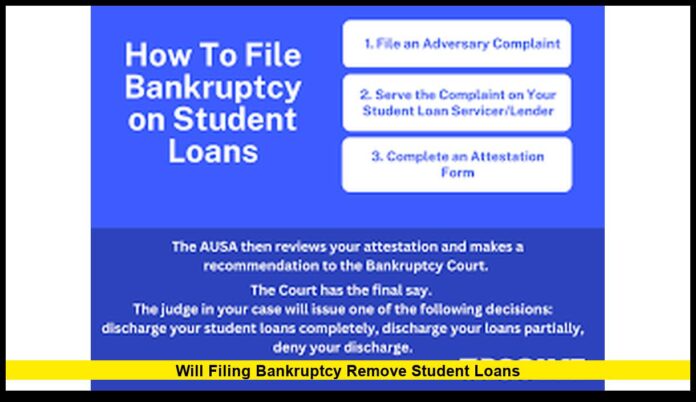
When a borrower files bankruptcy, student loans are included in the paperwork like other debts. However, they are not discharged at the end of the case unless the borrower takes an extra step.
That step is filing a separate legal action within the bankruptcy case asking the court to remove student loan debt. Without this action, the loans pass through bankruptcy unchanged.
Many borrowers are surprised by this outcome, which fuels confusion about what bankruptcy can realistically achieve.
Understanding the Undue Hardship Requirement
To discharge student loans in bankruptcy, borrowers must prove repayment would cause undue hardship. This standard is central to the entire process.
Courts evaluate hardship by examining the borrower’s financial situation in depth. Judges typically look at whether:
- The borrower can maintain basic living expenses while repaying loans
- The financial hardship is likely to continue for a significant period
- The borrower has made genuine efforts to repay the debt
All three factors must be satisfied. This high bar explains why successful student loan discharge cases remain uncommon.
Why Proving Undue Hardship Is Difficult
Many borrowers struggle to meet the legal threshold because courts require strong evidence. Temporary unemployment or short-term financial setbacks are usually not enough.
Judges often expect documentation showing long-term income limits, persistent medical issues, or other lasting constraints. The burden of proof rests entirely on the borrower.
Even borrowers facing serious financial strain may fail to meet all elements required for relief.
Important Developments That Affect Borrowers in 2025
Clearer Federal Review Standards
In recent years, federal agencies involved in bankruptcy cases adopted clearer standards for reviewing hardship claims. These updates created more consistent evaluation methods across cases.
Borrowers are now required to provide standardized financial disclosures, making the process more transparent. While the hardship standard still applies, the path is more structured than it once was.
This shift has encouraged more borrowers to explore the option, even though outcomes remain case-specific.
Ongoing Legislative Attention
Lawmakers continue to debate changes to how student loans are treated in bankruptcy. Proposed legislation introduced in 2025 aims to lower barriers for borrowers seeking relief.
As of now, no new law has taken effect. Student loans remain non-dischargeable by default, and hardship must still be proven. However, the attention signals that reform remains an active national issue.
Federal Student Loans and Bankruptcy
Federal student loans follow the strictest rules in bankruptcy. These loans are backed by the federal government and are rarely discharged without clear evidence of long-term hardship.
Borrowers with federal loans must demonstrate that repayment prevents them from meeting basic living needs and that their situation is unlikely to improve.
Even when collections are aggressive, bankruptcy alone does not remove the debt.
Private Student Loans and Bankruptcy Treatment
Private student loans are also not automatically discharged. However, their treatment can vary depending on loan structure and court interpretation.
Some private loans resemble traditional consumer debt more closely than federal loans. In such cases, courts may examine whether the loan truly qualifies for special protection under bankruptcy law.
Results depend heavily on loan documents, borrower history, and the facts presented to the court.
How Bankruptcy Can Still Provide Relief
Even when student loans remain after bankruptcy, the process can still offer meaningful financial breathing room.
Chapter 7 Bankruptcy Relief
Chapter 7 bankruptcy eliminates most unsecured debts in a relatively short time. During the case, collection actions stop, including lawsuits and wage garnishments.
This pause can help borrowers stabilize their finances and redirect income toward essential expenses or future loan management.
Chapter 13 Bankruptcy Relief
Chapter 13 bankruptcy places borrowers on a court-approved repayment plan lasting three to five years.
Student loan collections are paused during this period. Borrowers gain time to reorganize finances and address other debts that make repayment impossible.
Unless discharged through hardship, student loans usually remain at the end of the plan.
Why Student Loan Collections Matter in 2025
With emergency repayment pauses fully expired, student loan collections are active again nationwide. Wage garnishments, tax refund offsets, and benefit reductions are impacting borrowers across income levels.
This enforcement environment has pushed many households into financial distress. Bankruptcy becomes an option for managing overall debt, even when student loans are not eliminated.
The return of aggressive collection activity is a major driver behind renewed interest in bankruptcy options.
Common Misconceptions Borrowers Still Have
Many Americans believe bankruptcy automatically clears student loans. This misunderstanding often leads to disappointment when cases conclude.
Others assume private student loans are always easier to remove. While sometimes true, success depends on specific loan details and court findings.
Understanding the rules before filing helps borrowers avoid unrealistic expectations.
Key Facts Borrowers Should Remember
- Bankruptcy does not automatically remove student loans
- A separate court action is required to seek discharge
- Undue hardship remains the legal standard
- Federal loans are especially difficult to discharge
- Private loan outcomes vary by case
- Bankruptcy can still stop collections temporarily
- Other debts discharged through bankruptcy may ease repayment pressure
These points remain true across the United States today.
Evaluating Bankruptcy as a Strategy
Bankruptcy is a serious legal step with long-term credit consequences. For borrowers overwhelmed by multiple debts, it may offer relief even if student loans survive.
Reducing other obligations can free income and stabilize household finances. This can make future student loan repayment more manageable.
Borrowers should evaluate bankruptcy as part of a broader financial strategy, not as a guaranteed solution for student loans.
What the Future May Hold
While current law remains strict, public discussion around student loan bankruptcy relief continues. Policymakers, courts, and borrowers are paying closer attention to how educational debt affects long-term financial stability.
Any future changes would require new legislation or court rulings. Until then, borrowers must rely on existing standards.
Staying informed is essential as rules and interpretations evolve.
If you’re facing student loan pressure and considering bankruptcy, share your thoughts or experiences—your insight could help others navigating the same difficult decisions.

