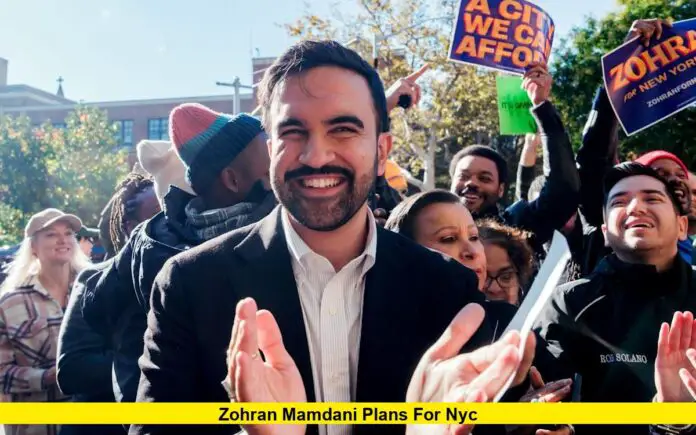
In his sweeping agenda, Zohran Mamdani has laid out comprehensive plans for NYC that aim to reshape daily life for millions of residents—from renters and transit riders to parents and workers. Fresh off his mayoral victory, his plans for NYC are no longer just campaign promises but a transition blueprint well underway, with clear policies, timelines and challenges ahead.
Table of Contents
Affordable Housing at the Center of the Vision
Housing is the cornerstone of Mamdani’s plans for NYC. Recognizing that many residents are “one rent increase away” from leaving the city, his agenda emphasizes supply, protections and public-sector leadership.
- He proposes the construction of 200,000 new affordable housing units over the next decade, targeted as “permanently affordable, union-built, rent-stabilized homes”. This marks an ambitious scale-up from prior housing efforts.
- His housing policy calls for freezing rent increases for millions of tenants in rent-stabilized units, aiming to mitigate displacement pressure in the short term.
- An overhaul of tenant protections and landlord enforcement is central: his platform speaks to “cracking down on bad landlords” and turning the public sector into the builder and maintainer of much of the housing stock.
- Mamdani also proposes new mechanisms such as a Social Housing Development Authority at the state level that would mobilize public financing and city‐owned land to speed up construction.
By placing housing supply and affordability at the heart of his plans for NYC, Mamdani is explicitly rejecting incremental reform in favor of structural change.
Transportation & Public Access: Free Buses and Beyond
One of the most visible elements of Mamdani’s plans for NYC is the idea of fare-free bus service citywide, paired with transit upgrades and equity in infrastructure.
- He supports making all city buses fare-free, building on a previous pilot that increased ridership by more than 30% on select routes. The policy is pitched as both economic relief and a climate strategy.
- His transit vision goes beyond bus fares: expanded service in under-served neighborhoods, improved bus infrastructure, and integration with other modes of public transit.
- These proposals underline how Mamdani wants his plans for NYC to affect everyday operations: riding the bus, accessing jobs, moving between boroughs—all become part of the affordability agenda.
By making public transit not only accessible but equitable, his agenda ties together cost relief and sustainable urban planning.
Childcare, Wages & Economic Opportunity
Mamdani’s plans for NYC also target the cost burdens faced by working families and low-income residents. The economic platform is built around stronger wages, universal care, and job creation.
- A key goal is raising the minimum wage to $30 per hour by 2030—a bold target in New York’s high-cost environment.
- Universal childcare is another pillar: offering no-cost care for children from six weeks up to five years of age to free working parents from steep childcare costs.
- Job creation is included via “Green Jobs NYC” and other public-works initiatives: creating employment in retrofits, infrastructure and sustainable housing while also expanding worker-ownership models and strengthening unions.
These intersecting strategies show how Mamdani’s plans for NYC go beyond relief and toward reshaping the city’s economy to benefit a broader set of residents.
Food Access, Grocery Reform & Community Infrastructure
Mamdani doesn’t stop at housing and transit—his plans for NYC extend into food access and neighborhood revitalization.
- His platform includes city-run grocery stores: one in each borough, aimed at lowering food prices and expanding fresh-food access in underserved areas.
- He links these grocery initiatives with his housing and transit goals: when neighborhoods are more affordable, transit is easier, and stores are accessible, the cost burden drops.
- Community infrastructure upgrades—green retrofits of schools, new public space, resilient hubs in neighborhoods—are woven into his broader vision for a city where services are embedded in local life.
This part of his agenda shows how his plans for NYC are not just about policy targeting, but about re-engineering the everyday cityscape.
Public Safety, Education & Governance Reform
Mamdani moves into public safety and education reform with the same structural ambition that defines his broader agenda.
- One key element is the creation of a Department of Community Safety, designed to handle mental-health emergencies, domestic issues and non-violent calls through social-workers rather than police. This reflects his belief that safety must evolve.
- On education: his platform calls for rethinking admissions systems for specialized high schools (e.g., the SHSAT), phasing out the kindergarten-level “Gifted & Talented” program and ensuring every child has access to high-quality early education.
- Governance reform: his transition team, announced shortly after his victory, includes figures from different sectors—public service, regulatory agencies, nonprofits—suggesting he intends to bring a fresh structure to city hall operations.
Through these policies, Mamdani shows that his plans for NYC span the full life cycle of city services: from how children are educated, to how communities are policed or supported.
Taxation, Budget & Implementation Realities
Ambition is one thing; implementation is another. Mamdani’s plans for NYC will hinge on financing, political will and institutional cooperation.
- To pay for his agenda, he proposes tax increases on corporations (raising corporate tax toward ~11.5%) and a new 2% tax on households earning over $1 million annually.
- He articulates the need to shift the city away from austerity and to lean into public investment—a marked departure from recent trends.
- However, some analysts caution about the feasibility: engaging with semi-independent bodies (housing boards, the transit authority), securing state legislative backing, and designing budgets that can sustain ambitious programs without disruption.
- Resistance is already evident: landlord groups warn that his housing plans may accelerate exits from the rent-stabilized market, transit agencies highlight financial risks of unpaid fares, and business coalitions worry about tax impacts.
Mamdani’s plans for NYC are bold—but the pathway to realising them will involve navigating multiple institutional and fiscal hurdles.
Why This Matters Now for New Yorkers
For everyday residents, the difference between policy talk and real change is lived in the cost of rent, the price of bus fares, the availability of childcare and the reliability of public services. Mamdani’s plans for NYC centre on altering those core experiences.
- Renters living in stabilized apartments could see stabilization of their rent growth and fewer threats of displacement.
- Working families might access free care, affordable transit, and greater wage security.
- Neighborhoods long overlooked might see new grocery stores, better local infrastructure and improved services.
- For the city at large, this agenda signals a push toward equity: ensuring that public investment is targeted where it matters most, rather than across the board.
His plans for NYC reflect a belief that affordability and fairness need to be built into the structure of the city—not just managed as after-thoughts.
Timeline & What’s Coming
Here’s how the rollout of his vision is expected to map out:
| Timeframe | Action | Significance |
|---|---|---|
| Now – late 2025 | Transition team activation, policy designs | Sets foundation for his administration. |
| Jan 1 2026 | Mamdani takes office | Marks the official start of governance. |
| 2026–2027 | Early implementation (rent freeze, free buses, childcare expansion) | Visible changes for residents. |
| 2028–2030 | Mid-term goals (minimum wage $30/hr, housing supply ramp-up) | Structural shift across major sectors. |
| 2030 and beyond | Evaluate legacy outcomes, institutional changes | Shows whether plans for NYC have taken root. |
Challenges and Criticisms
Even with strong public support, Mamdani’s plans for NYC face significant headwinds.
- Institutional resistance: Boards and agencies in control of major policy levers may not align perfectly with his agenda.
- Fiscal constraints: Funding massive housing builds, childcare programs and free transit will strain budgets unless supplemented by effective tax and bond measures.
- Market effects: Critics warn that rent freezes and heavy regulation could discourage investment or spur unintended consequences like housing shortages or landlord exit strategies.
- Political obstacles: He must build coalitions across city council, state lawmakers and stakeholders who may oppose large shifts in tax and service priorities.
The success of Mamdani’s plans for NYC will depend as much on execution and negotiation as on the ideas themselves.
What to Watch
If you follow how Mamdani’s plans for NYC unfold, keep tabs on the following:
- How quickly a rent freeze or stabilization policy is introduced and what scale it covers.
- The rollout timeline for fare-free bus service: budget impact, ridership data and service coverage.
- Childcare expansion: how many families are enrolled, funding sources and whether universal care truly becomes accessible.
- Housing unit production: whether the 200,000-unit target is met or whether the focus shifts to smaller numbers/longer timelines.
- Tax policy passage: if corporate and high-income tax changes get approved and how business community responds.
These indicators will show whether the ambitious plans for NYC are shifting from blueprint to reality.
In sum, Zohran Mamdani’s plans for NYC reflect an integrated vision: housing, transit, wages, childcare, community access and governance reform all tied together under the banner of affordability and equity. The agenda is broad, the ambitions high, and the path forward full of complexities. But for many New Yorkers, this may mark the most transformative mayoral agenda they’ve seen in decades.
What part of Mamdani’s plans for NYC do you care about most—rent relief, free transit, universal childcare or something else entirely? Share your thoughts and keep following how this vision unfolds.

