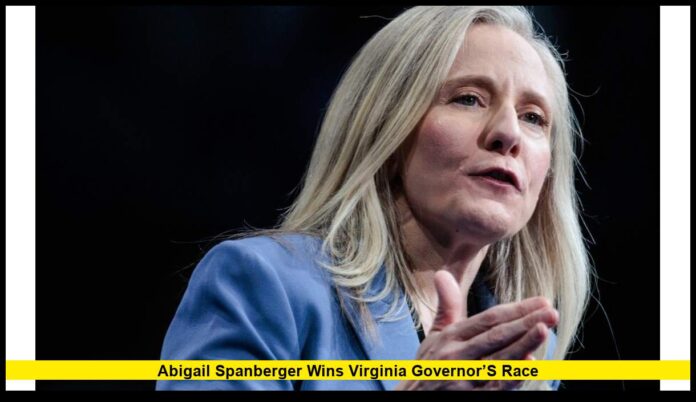
In a landmark victory for the Democratic Party, Abigail Spanberger wins Virginia Governor’s race, securing the top post in the Commonwealth of Virginia. Spanberger, a former U.S. Representative and ex-CIA case officer, defeated Republican Lieutenant Governor Winsome Earle-Sears by a decisive margin, making history as Virginia’s first female governor.
Table of Contents
Historic Win and What It Means
The race culminated on November 4, 2025, when projections confirmed that Spanberger would become the 75th governor of Virginia, succeeding outgoing Republican Governor Glenn Youngkin, who was term-limited.
Spanberger captured approximately 57 % of the vote, while Earle-Sears garnered around 43 %, reflecting a roughly 14-point margin in a statewide race that was widely viewed as a bellwether for national politics.
The victory is significant on multiple fronts:
- Spanberger becomes Virginia’s first woman to hold the office of governor.
- The win occurs amid a broader Democratic sweep in statewide offices, signaling shifting political dynamics.
- It positions Virginia’s Democrats for unified state government control—an outcome with major implications for future policy and congressional map-drawing ahead of 2026.
Spanberger’s Background and Campaign Focus
Abigail Spanberger, born August 7, 1979, in New Jersey, moved to Virginia as a teenager and later served in Congress representing Virginia’s 7th District from 2019 to 2025. Prior to her congressional service, she served as a CIA case officer and federal law enforcement agent, giving her a reputation for integrity and bipartisan pragmatism.
Her campaign emphasized key issues that resonated with a broad voter base:
- Economic Growth: Boosting small businesses, attracting high-tech jobs, and improving the state’s infrastructure.
- Public Safety: Strengthening law enforcement partnerships and ensuring accountability in policing.
- Education: Raising teacher pay, expanding early-childhood education, and improving public school resources.
- Pragmatism Over Partisanship: Focusing on problem-solving rather than political division.
Spanberger’s measured tone and results-oriented message appealed to both suburban moderates and rural independents. Her campaign maintained a disciplined focus on issues rather than personal attacks, helping her expand support in Northern Virginia, Richmond, and the Tidewater region.
Election Night & Statewide Results
On election night, Spanberger addressed a crowd of supporters in Richmond, declaring that Virginia had chosen “pragmatism over partisanship.” The atmosphere reflected optimism for Democrats and a moment of historic change for the Commonwealth.
Key Statewide Results:
- Governor: Abigail Spanberger (D) – 57 %; Winsome Earle-Sears (R) – 43 %.
- Lieutenant Governor: Ghazala Hashmi (D) – first Muslim woman elected to statewide office in Virginia.
- Attorney General: Jay Jones (D) – defeated incumbent Republican Jason Miyares.
- Legislative Control: Democrats appear poised to expand their majority in the Virginia House of Delegates, opening the door to a unified Democratic government.
This series of victories underscores a strong Democratic performance across Virginia and marks a major political shift from the Republican gains of previous years.
Why This Victory Matters
Virginia’s gubernatorial elections often act as a national political barometer. Spanberger’s victory has wide-ranging implications:
- A Shift in Political Momentum: The result reflects a resurgence of Democratic strength in a state that had trended Republican under Youngkin’s leadership.
- National Impact: As one of the earliest statewide elections before the 2026 midterms, the outcome boosts Democratic morale and fundraising momentum nationwide.
- Women in Leadership: Spanberger’s victory adds to the growing number of women leading U.S. states and could inspire further progress in political representation.
- Policy Implications: With Democrats controlling the governorship and likely both legislative chambers, Virginia is expected to advance policies focused on renewable energy, public education, healthcare affordability, and reproductive rights.
Spanberger’s reputation as a moderate Democrat could help bridge divides in a politically diverse state, making Virginia a model for bipartisan governance in a polarized national environment.
Challenges Ahead for Spanberger’s Administration
While the victory is historic, Spanberger faces immediate challenges as she transitions from campaigning to governing:
- Economic Stability: Managing inflation pressures while expanding Virginia’s competitive edge in tech and manufacturing sectors.
- Education Reform: Delivering on promises to raise teacher pay and modernize the public education system.
- Healthcare Access: Expanding Medicaid programs and improving mental-health services.
- Infrastructure & Housing: Addressing congestion in Northern Virginia, enhancing rural connectivity, and making housing more affordable statewide.
- Balancing Political Forces: Working with a legislature that, while likely Democratic, contains diverse ideological wings.
Spanberger’s leadership style—collaborative, detail-driven, and focused on consensus—may prove crucial in steering the state through these challenges.
National Reactions and Political Impact
Political observers nationwide have highlighted the importance of this election. Democrats view Spanberger’s success as a strong indicator that centrist, pragmatic messages can resonate in swing states. Republicans, meanwhile, are likely to reassess their campaign strategies ahead of 2026, especially in suburban districts that swung decisively toward Democrats.
Spanberger’s win also bolsters her standing as a rising national figure within the Democratic Party. Her moderate record and intelligence background make her a compelling voice on national security, governance, and bipartisanship. Some analysts believe her governorship could position her for future federal roles or even national leadership consideration.
The outcome further reflects changing demographics across Virginia: suburban growth, increased voter participation among younger and minority voters, and an electorate that values stable, issue-focused leadership.
What’s Next for Virginia
Abigail Spanberger will officially be sworn in as governor on January 17, 2026, alongside Lieutenant Governor Ghazala Hashmi and Attorney General Jay Jones. Her administration will prioritize immediate legislative action on education funding, small-business relief, and renewable-energy expansion.
Early reports suggest her transition team is already assembling experienced figures from both the public and private sectors to ensure a smooth shift of power. Her first 100 days are expected to focus on bipartisan legislation designed to unite Virginians under a shared vision of pragmatic progress.
Spanberger’s victory marks a defining moment for Virginia—a reflection of its evolving political identity and its role as a national test case for moderate leadership in a divided political era.
Bold Closing Line:
Abigail Spanberger’s win as Virginia’s first female governor marks a new era for the Commonwealth—share your thoughts below and stay tuned for more updates!

