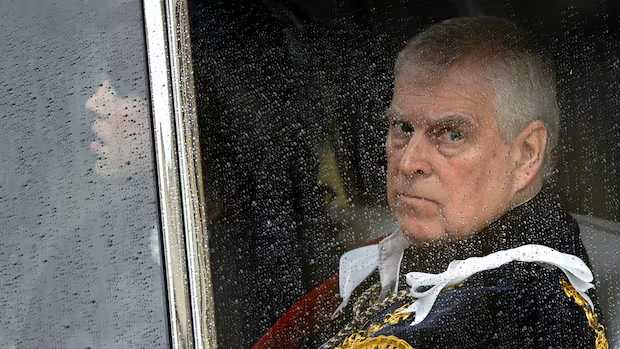
The British royal family has witnessed many controversies through the centuries, but few moments have shaken its core as deeply as this one — Prince Andrew has officially been stripped of his title. Once known as “His Royal Highness” and the Duke of York, Andrew is now simply Andrew Mountbatten-Windsor. The decision, confirmed in late October 2025, marks a seismic moment in modern royal history — one that redefines accountability, legacy, and the limits of privilege within the House of Windsor.
Table of Contents
A Royal Title Lost Forever
After months of speculation and mounting public outrage, Buckingham Palace released an official statement confirming that King Charles III had initiated formal action to remove all of Andrew’s remaining royal titles and privileges. The move came after years of controversy, stemming from Andrew’s association with convicted sex offender Jeffrey Epstein and the civil lawsuit filed against him by Virginia Giuffre.
The palace statement was brief but decisive: Andrew would no longer hold, use, or be addressed by any royal title. His full name going forward would be “Andrew Mountbatten-Windsor.” With that single declaration, a man who had once stood at the heart of Britain’s most powerful institution was effectively erased from its official framework.
Observers noted that such a move was almost unprecedented in modern royal history. While royals have stepped back or renounced titles voluntarily before, being formally stripped of them is an entirely different matter — it signals permanent exclusion, not self-imposed exile.
The Long Road to This Moment
The fall of Prince Andrew did not happen overnight. It unfolded slowly, painfully, and very publicly.
In the late 2010s, Andrew was still performing royal duties, attending events, and representing the Crown abroad. However, his friendship with Epstein — a billionaire financier later convicted of sex crimes — began to haunt him. When Epstein died in prison in 2019, questions about Andrew’s relationship with him intensified.
That same year, Andrew agreed to sit down for what became one of the most disastrous interviews in royal media history. Speaking to the BBC’s Newsnight, he attempted to defend himself against allegations made by Virginia Giuffre, who accused him of sexual misconduct when she was a minor. His answers — dismissive, awkward, and at times unbelievable — triggered widespread outrage.
Within days, Andrew stepped back from royal duties “for the foreseeable future.” But public opinion had already turned sharply against him.
By 2022, he reached an out-of-court settlement with Giuffre in the United States, without admitting guilt. The payment reportedly exceeded £10 million, funded in part by the Queen’s private estate. The scandal, however, did not fade.
As King Charles ascended to the throne after Queen Elizabeth II’s death in 2022, he made it clear that the monarchy would move toward “a streamlined, accountable” model — one built on service, not privilege. Under this new royal vision, Andrew’s place became increasingly untenable.
The Final Straw for King Charles
Insiders say the decision to strip Andrew of his title was not made overnight. The King reportedly wrestled with the issue for months, balancing family loyalty with public expectation. But the publication of Virginia Giuffre’s memoir in October 2025 — and the resurgence of public anger that followed — made inaction impossible.
Behind palace doors, a quiet but firm process began. Advisors reviewed the legal and constitutional framework for removing royal titles, consulting with ministers and constitutional experts. The conclusion: the King had both the moral and procedural authority to act.
By late October, the decision was finalized. Andrew was informed privately before the official announcement.
The royal family’s internal tone, according to insiders, was one of sadness but necessity. “This is not vengeance,” one aide reportedly said. “It is the natural consequence of actions that have made his continued association with the monarchy impossible.”
What Andrew Has Lost
The decision to strip Prince Andrew of his title carries profound symbolic and practical consequences.
- His Title: He will no longer be addressed as “Prince Andrew” or “His Royal Highness.”
- His Dukedom: The title “Duke of York,” once synonymous with his identity, has been withdrawn from public use.
- Royal Patronages: More than 230 charitable and honorary associations have severed ties with him permanently.
- Military Affiliations: His honorary military appointments, once prestigious and public, have been removed entirely.
- Royal Residence: Andrew has been asked to vacate the Royal Lodge at Windsor, a property he occupied for over two decades. He will move to private accommodation on the Sandringham estate.
In practice, this leaves Andrew with no formal role, no public duties, and no visible royal identity. Though he retains the courtesy of family connection, he no longer has a position within “The Firm.”
Public Reaction: A Kingdom Divided
The British public’s reaction has been mixed — but largely supportive of the King’s decision. Many believe it was long overdue.
Opinion polls show more than 70% of Britons agreeing that Andrew should lose his titles permanently. Advocacy groups for survivors of sexual abuse called the move “a symbolic but vital act of accountability.” Others saw it as a moment of reckoning for an institution long accused of protecting its own.
On social media, public sentiment was less forgiving. Some users described the decision as “justice, delayed but not denied,” while others questioned why it took so long.
Among royal watchers, the move is being hailed as one of King Charles’s boldest acts since his coronation — a decision that signals moral leadership in a time when public trust in institutions is fragile.
Inside the Palace Response
Reports suggest that the royal family is now working to quietly manage the aftermath. Queen Camilla and the Prince of Wales are believed to have supported the King’s decision. Princess Anne, known for her no-nonsense approach, reportedly described it as “inevitable.”
Meanwhile, Prince William and Princess Catherine are said to believe the move will “help the monarchy move forward.” Both have reportedly emphasized the importance of restoring dignity and focus to the royal brand — especially as younger generations grow more skeptical of inherited privilege.
What Lies Ahead for Andrew Mountbatten-Windsor
For the man once styled “Prince Andrew, Duke of York,” the road ahead is uncertain. Stripped of his title, his public identity has vanished. He remains a member of the royal family by blood but not by duty or distinction.
Those close to him say he intends to live a quiet life away from public scrutiny. He is expected to relocate to a smaller property within the royal estate, where he will live privately and rely on personal savings and family support.
While some sources suggest he may pursue charitable or humanitarian work in the future, most experts agree that any public comeback is highly unlikely. His reputation has been irreparably damaged, and the monarchy’s decision leaves little room for a return.
A Turning Point for the Modern Monarchy
The stripping of Andrew’s title marks more than the downfall of one man — it represents a broader transformation of the monarchy itself.
Under King Charles III, the institution is redefining what it means to serve, represent, and remain accountable in the public eye. The move sends a message that even those born into privilege are not above consequence.
It also reflects the royal family’s shifting priorities: less focus on hierarchy, more emphasis on public trust. For a monarchy that thrives on symbolism, this act was a powerful declaration — the old ways of silent tolerance are over.
Experts believe the incident will influence how the Crown handles future crises, whether they involve public conduct, personal scandal, or institutional responsibility. The King’s message is clear: the royal family must live by the same standards expected of the people it serves.
A Fall Without Precedent
It is difficult to overstate the significance of this moment. For centuries, royal titles have been seen as permanent — symbols of divine right and noble heritage. To lose them is to lose a part of one’s identity.
Prince Andrew’s fall from grace illustrates how dramatically the balance between tradition and accountability has shifted in modern times. What was once unimaginable — a prince stripped of his title — is now reality.
In the grand history of the British monarchy, this decision will be remembered not just as a scandal, but as a landmark of reform.
Once adorned with medals and royal titles, Prince Andrew now faces the future not as a royal, but as a man stripped of title and privilege. His story is a reminder that power can be inherited, but honor must be earned.
What do you think about this historic royal decision? Share your thoughts below and join the conversation.

