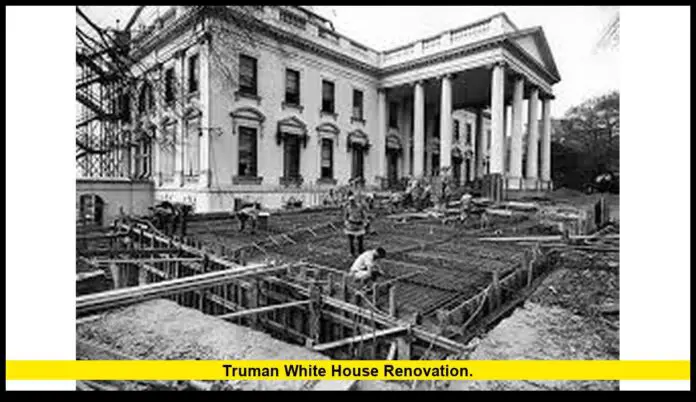
The Truman White House renovation remains one of the most significant architectural undertakings in American history — a project that saved the nation’s most iconic residence from collapse and transformed it into the structurally sound, modern Executive Mansion that stands today. Between 1948 and 1952, President Harry S. Truman oversaw a complete gutting and rebuilding of the White House interior, a decision that would ensure the building’s survival for generations to come.
Now, more than seventy years later, this historic renovation continues to serve as a benchmark for every White House remodeling effort that has followed, including the recently announced modernization and expansion projects.
Table of Contents
Why the Truman White House Renovation Was Necessary
By the late 1940s, the White House was in peril. The residence had not undergone major structural repairs since the early 19th century. Wooden beams were rotting, floors sagged under the weight of decades of modifications, and portions of the ceiling threatened to cave in.
When engineers conducted a full inspection in 1948, they concluded that the building was on the verge of collapse. The discovery came after a chandelier in the Blue Room swayed and the floors below creaked ominously during a state reception.
Faced with a dire safety warning, President Harry S. Truman ordered a complete renovation. Rather than risk further deterioration, he approved plans to dismantle and rebuild the White House interior from the ground up — preserving the outer walls but replacing everything within.
How the Renovation Was Carried Out
The Truman White House renovation was not a simple repair job; it was an extraordinary reconstruction that took four years to complete.
Key steps included:
- Full Interior Demolition: Workers stripped the White House down to its exterior sandstone walls, removing floors, ceilings, and internal supports.
- Structural Reinforcement: A new steel frame was installed to replace the original wooden structure, making the building far more durable and fire-resistant.
- Modern Infrastructure: Outdated wiring, plumbing, and heating systems were replaced with state-of-the-art utilities for the mid-20th century.
- Reconstruction of Rooms: Iconic spaces such as the East Room, State Dining Room, and Lincoln Bedroom were carefully rebuilt, maintaining their historical design but improving safety and function.
During construction, the Truman family moved across Pennsylvania Avenue to Blair House, where they lived for nearly four years until the project’s completion in 1952.
The Cost and Scale of the Project
In total, the renovation cost approximately $5.7 million — equivalent to more than $70 million in today’s dollars. At the time, the cost drew criticism from some members of Congress, but the alternative — allowing the White House to collapse — was unthinkable.
The massive scale of the operation involved:
- More than 125,000 square feet of internal space being rebuilt.
- Installation of over 150 tons of structural steel.
- New plumbing and electrical systems spanning every room and corridor.
- Complete redesign of the White House basement, including the addition of a bomb shelter and new storage areas.
By the end of the project, the White House was both structurally sound and equipped for a new era of presidential use.
The Hidden Modern Additions
While the Truman White House renovation focused on preserving the building’s historical character, several modern upgrades were quietly added during reconstruction.
- Air Conditioning: For the first time, the White House received a complete central air conditioning system.
- Secret Service Facilities: New security posts and communications rooms were integrated discreetly into the design.
- Basement Expansion: A reinforced basement provided both additional storage and emergency space.
- Elevator Installations: New elevators improved accessibility for staff and guests, replacing outdated manual lifts.
These innovations made the White House not just beautiful, but functional and safe for the demands of the modern presidency.
Public Reaction and Legacy
When President Truman returned to the renovated White House in March 1952, the project was hailed as a triumph of preservation and modernization. The exterior appeared unchanged — a deliberate choice to maintain the nation’s most symbolic façade — but inside, nearly every element was brand new.
Public tours resumed later that year, and Americans were astonished by how seamless the restoration appeared. Critics who had initially questioned the expense later acknowledged that the renovation had saved an irreplaceable piece of American heritage.
Today, the Truman renovation stands as one of the most remarkable architectural feats ever undertaken in the United States government.
Comparing Then and Now: Renovation Milestones
| Aspect | Truman Renovation (1948–1952) | Modern Renovation Projects (2020s) |
|---|---|---|
| Scope | Complete interior reconstruction | Selective modernization and expansion |
| Purpose | Prevent structural collapse | Expand space and improve facilities |
| Duration | 4 years | Ongoing (multi-phase) |
| Cost | $5.7 million (≈$70M today) | Estimated $200+ million |
| President Involved | Harry S. Truman | Current administration |
| Main Feature Added | Steel framework and modern utilities | New East Wing ballroom and tech systems |
The Truman project remains the gold standard by which all future White House work is measured — both in scope and importance.
Preserving History for Future Generations
The Truman White House renovation was about more than architecture; it was about ensuring that the “People’s House” would remain a symbol of American resilience. Truman’s decision to rebuild the White House was bold and controversial, but it guaranteed that the nation’s most famous home would stand strong for centuries.
Every president since has benefited from his foresight. The strong steel structure, the modernized utilities, and the preservation-first mindset remain central to White House maintenance and upgrades even today.
Architects and preservationists often describe Truman’s renovation as “surgery without changing the face” — preserving tradition while embedding strength beneath the surface. That philosophy continues to guide White House modernization efforts in the 21st century.
A Living Legacy
More than seventy years after the last beam was placed, the Truman White House renovation continues to shape how Americans view the presidency and national heritage. Every official event, press conference, and state dinner held inside those reinforced walls is a direct testament to Truman’s leadership and vision.
The renovation not only saved a building; it preserved a symbol. It turned a crumbling structure into a fortress of democracy — one that continues to serve as both home and workplace for the nation’s leader.
The Truman White House renovation remains a timeless example of how America can honor its past while building for the future. What do you think about the legacy of Truman’s bold reconstruction? Share your thoughts below.

 saved the presidential home from collapse, modernized it with steel support, and defined its lasting legacy.)